top of page
Triadica sebifera
(L.) Small
Chinese Tallow
Euphorbiaceae
Triadica sebifera is a deciduous species of tree in the family Euphorbiaceae. It is native to East Asia, and is cultivated for ornament and for the oily substances in its seeds, and has become invasive in the United States.
Description
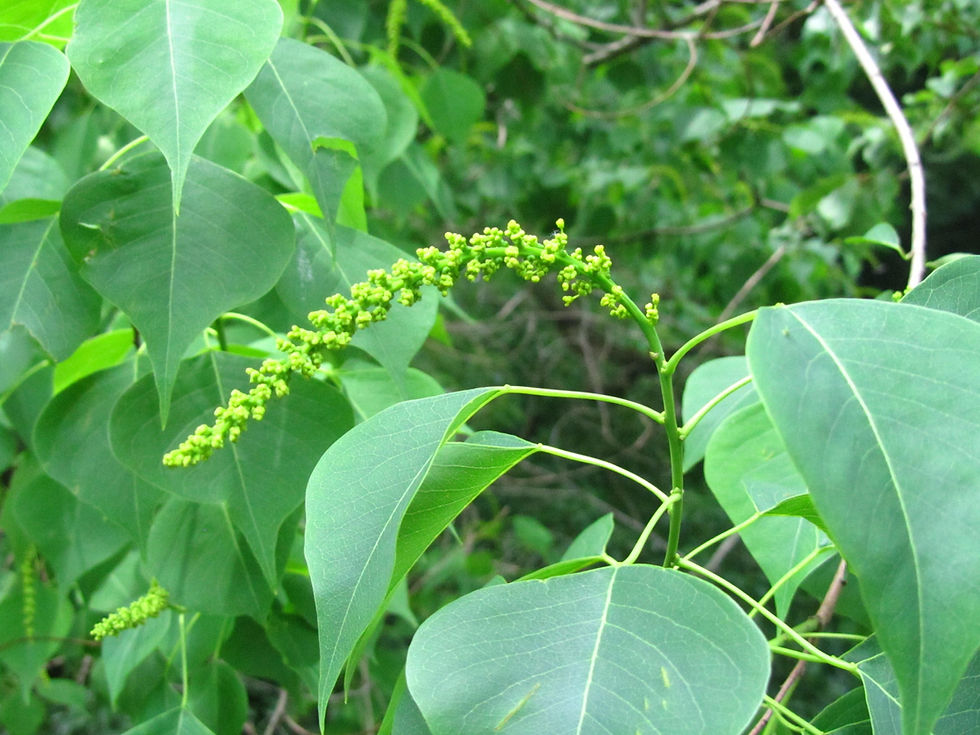
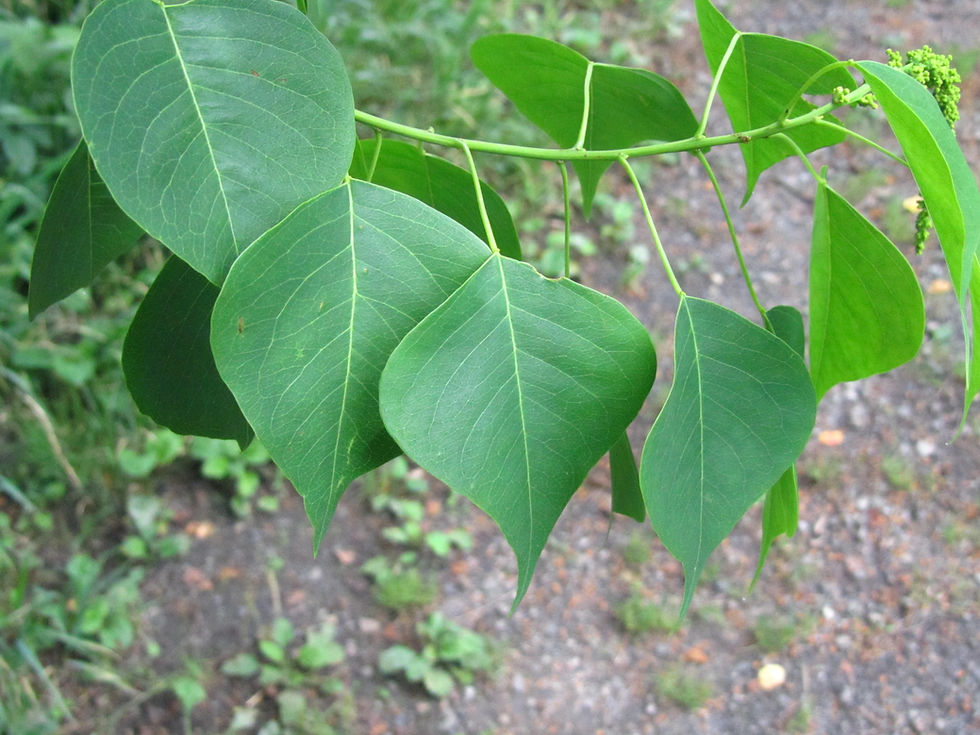
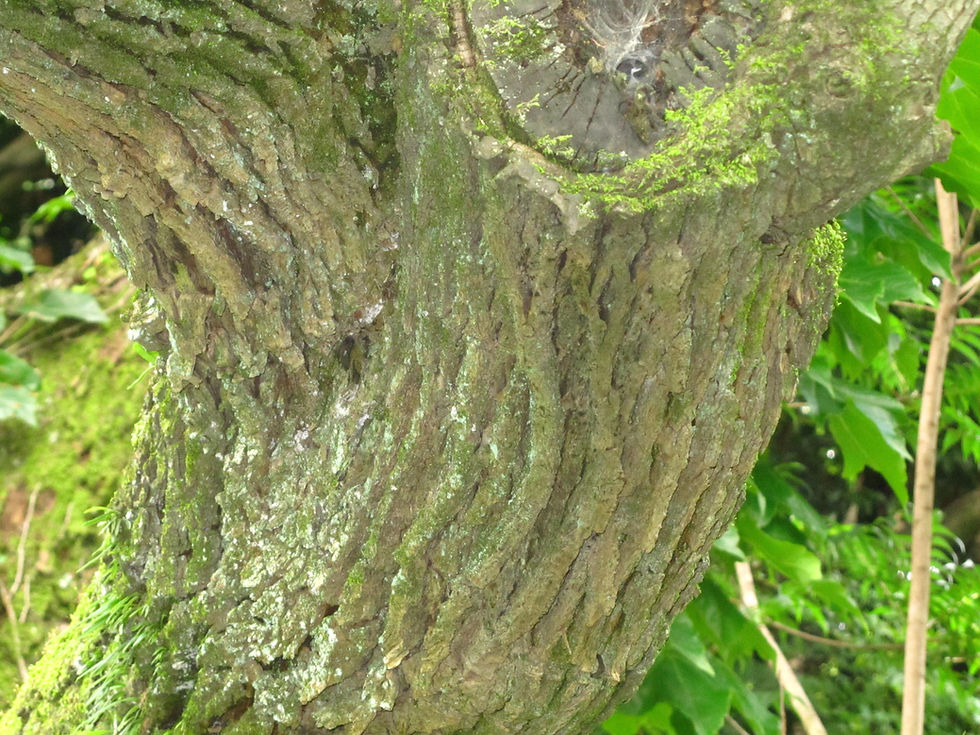
Triadica sebifera is a deciduous tree that grows up to 13 m tall. Leaves are alternate and simple, the blade very broadly elliptic in outline, 3.5 to 10 cm long and 3 to 9.5 cm wide, on a petiole that is 2 to 7 cm long. The base of the leaf blade is obtuse, while the apex tapers to a long point. Leaf margins are smooth and untoothed. At the base of the leaf blade on the petiole is a pair of glands 0.3 to 0.7 mm in diameter. The fall color is dark orange to purple. The bark is coarsely furrowed when mature. Triadica sebifera, like the rest of its genus, is monoecious, with separate male and female flowers on the same tree. The yellowish-green flower spikes grow from the tips of branches during the summer, and are 4 to 16 cm long. Pistillate (female) flowers are near the base of the flower spikes, on pedicels 2 to 3 mm long, 3 small sepals, and a small bract. Staminate (male) flowers are borne in clumps near the base of the flower spikes, also on pedicels 2 to 3 mm long, with 3 small sepals, and with anthers 0.4 mm long on filaments 0.4 to 0.7 mm long. The fruit is a three-seeded, round capsule that is about 13 mm wide, on a pedicel 4 to 13 mm long. It matures to split open along three lines, exposing the seeds, which are 6 to 9 mm long and covered in a thick white coating (Esser 2002; Sibley 2009).
Triadica sebifera is part of a small genus of trees native to Asia, distinguished by glandular petioles and white seed coats (hence the nickname “popcorn tree”) (Sibley 2009; Esser 2002). Unlike other flowering plants which tend to be distinguished based on their flowers and fruits, these three species differ the most in their leaf characteristics. Triadica rotundifolia has leaves with a nearly circular outline; Triadica cochinchinensis has longer leaves that are 1.5 to 2.6 times longer than wide (Esser 2002).
Triadica sebifera is part of a small genus of trees native to Asia, distinguished by glandular petioles and white seed coats (hence the nickname “popcorn tree”) (Sibley 2009; Esser 2002). Unlike other flowering plants which tend to be distinguished based on their flowers and fruits, these three species differ the most in their leaf characteristics. Triadica rotundifolia has leaves with a nearly circular outline; Triadica cochinchinensis has longer leaves that are 1.5 to 2.6 times longer than wide (Esser 2002).
Uses
Note: Please see the disclaimer regarding any information about medical or edible uses.
The seeds and seed coats of Triadica sebifera are economically important, since they contain stillingia tallow (also called Chinese vegetable tallow) and stillingia oil, respectively. Stillingia tallow is used for making soaps and candles, while stillingia oil is a drying oil. It is also used for timber and as a source for black dye (Esser 2002). It is often grown as an ornamental, although it self-seeds and can be invasive. It prefers well-drained soils in full sun, and its deep taproot allows it to survive periods of drought. It grows in USDA zones 8 to 10 (MBG).
Distribution
Triadica sebifera is found in a wide variety of forest and soil types, and can even tolerate some flooding; it grows at elevations up to 1700 m. It is native to China and Taiwan, south and east of Gansu province, southern Japan, and Vietnam. It is cultivated around the world and often escapes (Esser 2002; FNAEC 2016). It has become naturalized and invasive in the southern United States, from Texas to North Carolina, and California. It was found naturalized in Kentucky, but eradicated (FNAEC 2016).
Status
Triadica sebifera is listed on the IUCN Red List as “Least Concern”, because it is widespread with a large population, and its population is not known to be decreasing or facing any significant threats (Ye et al. 2019).
References
Esser, H.-J. 2002. A Revision of Triadica Lour. (Euphorbiaceae). Harvard Papers in Botany, 7: 17–21.
FNAEC (Flora of North America Editorial Committee), editor. 2016. Flora of North America, north of Mexico. Volume 12: Magnoliophyta: Vitaceae to Garryaceae. New York: Oxford University Press.
MBG (Missouri Botanical Garden), Triadica sebifera. Plant Finder. [accessed 2022 Aug 22]. https://www.missouribotanicalgarden.org/PlantFinder/PlantFinderDetails.aspx?taxonid=368407
Sibley, D. A. 2009. The Sibley Guide to Trees. New York: Alfred A. Knopf.
Ye, J., BGCI (Botanic Gardens Conservation International), and GTSG (IUCN SSC Global Tree Specialist Group). 2019. Triadica sebifera. The IUCN Red List of Threatened Species. https://dx.doi.org/10.2305/IUCN.UK.2019-2.RLTS.T18435729A147645142.en.
FNAEC (Flora of North America Editorial Committee), editor. 2016. Flora of North America, north of Mexico. Volume 12: Magnoliophyta: Vitaceae to Garryaceae. New York: Oxford University Press.
MBG (Missouri Botanical Garden), Triadica sebifera. Plant Finder. [accessed 2022 Aug 22]. https://www.missouribotanicalgarden.org/PlantFinder/PlantFinderDetails.aspx?taxonid=368407
Sibley, D. A. 2009. The Sibley Guide to Trees. New York: Alfred A. Knopf.
Ye, J., BGCI (Botanic Gardens Conservation International), and GTSG (IUCN SSC Global Tree Specialist Group). 2019. Triadica sebifera. The IUCN Red List of Threatened Species. https://dx.doi.org/10.2305/IUCN.UK.2019-2.RLTS.T18435729A147645142.en.
Description
bottom of page