top of page
Thelypteris parasitica
(L.) Tardieu
Parasitic Maiden Fern
Thelypteridaceae
Thelypteris parasitica is a species of fern in the family Thelypteridaceae. It is native to southeastern China, Taiwan, Japan, Korea, and the Philippines.

Description
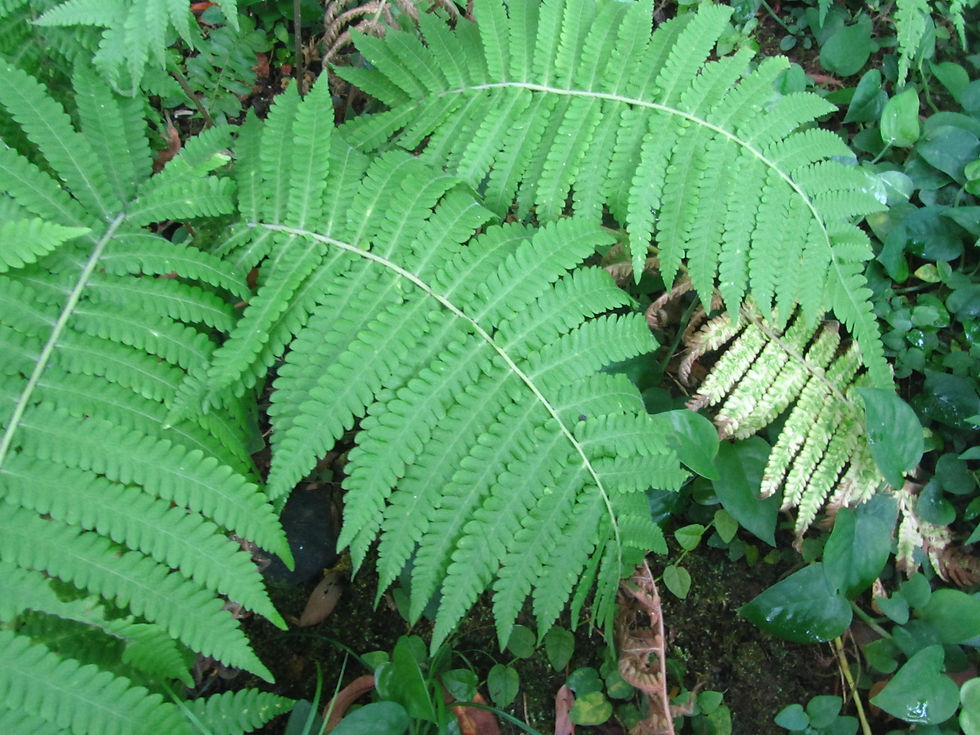
Thelypteris parasitica grows up to 70, occasionally up to 100 cm tall. Its rhizomes are creeping, and the leaf stipes have brown lanceolate scales. Leaves are pinnate. The leaf blade is roughly 30 to 50 cm long and 15 to 25 cm wide on a 20 to 30 cm long, yellowish stipe. The tip of the leaf is long-pointed. Leaflets come in 10 to 15 pairs, typically lanceolate. They are 10 to 15 cm long and 1 to 1.5 cm wide, relatively blunt-tipped, and deeply pinnately lobed. Sori are round, and indusia are densely hairy (Wu et al. 2013). It is unclear why the species is named "parasiticum", which is Latin for "parasitic" (Palmer 2008).
Uses
Note: Please see the disclaimer regarding any information about medical or edible uses.
Distribution
Thelypteris parasitica grows in thickets and along roads, at an altitude of up to 1900 m. It is widespread in Asia, native to Japan, Korea, China, Nepal, India, Sri Lanka, Myanmar, Thailand, Vietnam, Laos, the Philippines, and Indonesia (Wu et al. 2013). It has also been documented in Oceania, although it is unknown whether the species has been brought by humans to those areas. In Hawaii it is an invasive species (Buddenhagen 2013).
Status
References
Buddenhagen, C. 2013. Cyclosorus parasiticus (parasitic maiden fern). <i>Invasive Species Compendium</i>. <a>www.cabi.org/isc/datasheet/120368</a><br><br>Palmer, D. D. 2008. <i>Hawaiʹi's Ferns and Fern Allies</i>. University of Hawaiʹi Press.<br><br>Wu, Z. Y., Raven, P. H., and Hong, D. Y., eds. 2013. <i>Flora of China. Vol. 2-3 (Lycopodiaceae through Polypodiaceae)</i>. Beijing: Science Press, and St. Louis: Missouri Botanical Garden Press.
Description
bottom of page