top of page
Pyrrosia lingua
(Thunb.) Farw.
Tongue Fern
Polypodiaceae
Pyrrosia lingua is a species of fern in the family Polypodiaceae. It is native to eastern and southeastern Asia, and is used for its medicinal properties.
Description
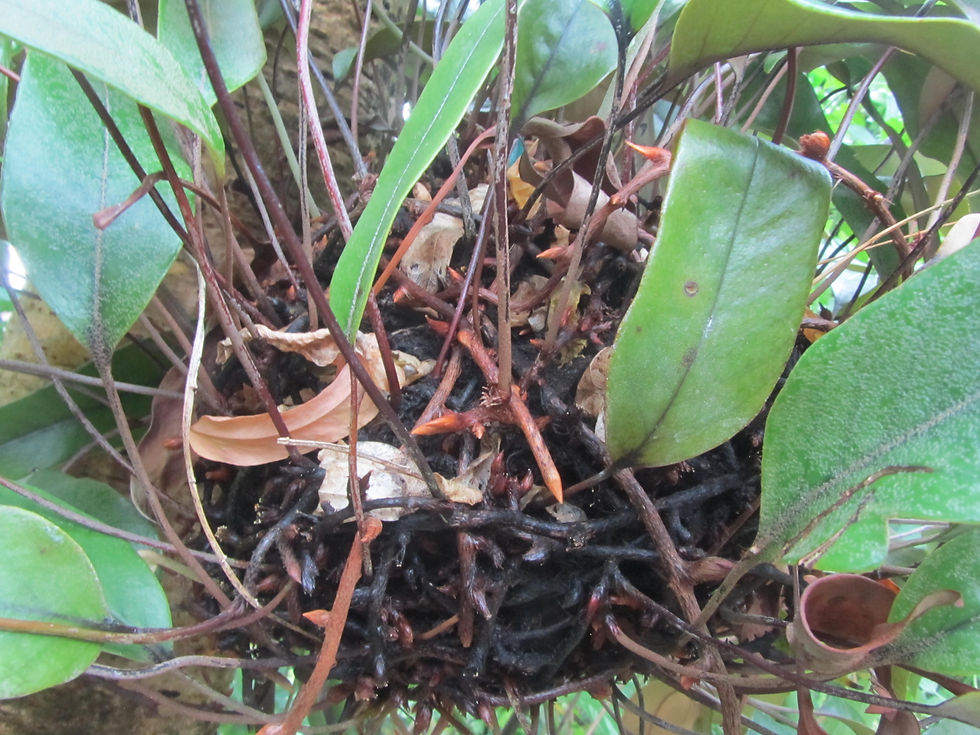
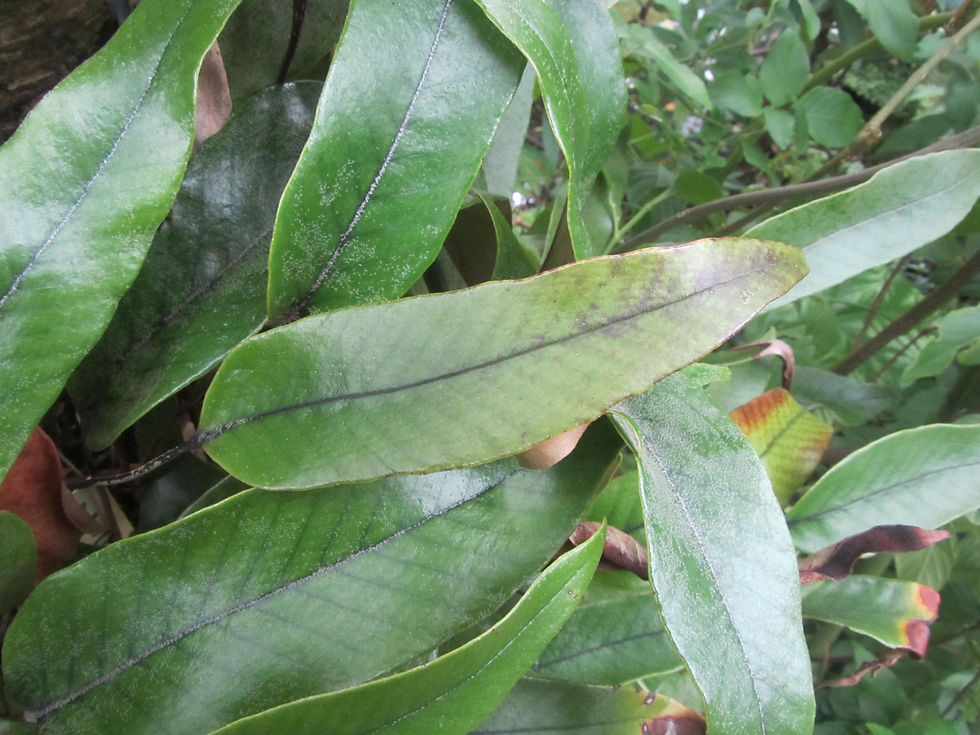
Pyrrosia lingua is often an epiphyte, growing up to 30 cm tall. Rhizomes are a few mm in diameter, covered with tiny scales. The scales are 4 to 9.5 mm long and about 1 mm wide, peltate, brown. Leaves are dimorphic. Sterile fronds are lanceolate, 10 to 20 cm long and 1.5 to 7 cm wide on a 1 to 30 cm long stipe; the base is wedge-shaped and the tip is long-pointed. Fertile fronds are narrower and longer, 5.5 to 22 cm long and 0.8 to 3 cm wide, widest below or at the middle. Surfaces are hairy, light or grayish brown. Sori are borne on the lower side of fertile fronds (Wu et al. 2013).
Uses
Note: Please see the disclaimer regarding any information about medical or edible uses.
The whole of the plant is used medicinally, to treat diuresis, inflammation, burns, and other problems of internal organs (Quattrocchi 2012).
Distribution
Pyrrosia lingua grows on tree trunks or dry rocks, often in forests, at an altitude of 100 to 1900 m. It is native to southeastern and eastern China, as well as Japan, the Korean Peninsula, India, Myanmar, and Vietnam (Wu et al. 2013).
Status
References
Quattrocchi, U. 2012. CRC World Dictionary of Medicinal and Poisonous Plants Common Names, Scientific Names, Eponyms, Synonyms, and Etymology. Boca Raton, FL: CRC Press.
Wu, Z. Y., Raven, P. H., and Hong, D. Y., eds. 2013. Flora of China. Vol. 2-3 (Lycopodiaceae through Polypodiaceae). Beijing: Science Press, and St. Louis: Missouri Botanical Garden Press.
Wu, Z. Y., Raven, P. H., and Hong, D. Y., eds. 2013. Flora of China. Vol. 2-3 (Lycopodiaceae through Polypodiaceae). Beijing: Science Press, and St. Louis: Missouri Botanical Garden Press.
Description
bottom of page