top of page
Psilotum nudum
(L.) P.Beauv.
Whisk Fern
Psilotaceae
Psilotum nudum, is a plant in the family Psilotaceae. It is a pantropical species. Its family, Psilotaceae, along with the Ophioglossaceae, are a sister group to all other ferns (Smith et al. 2006).
Description
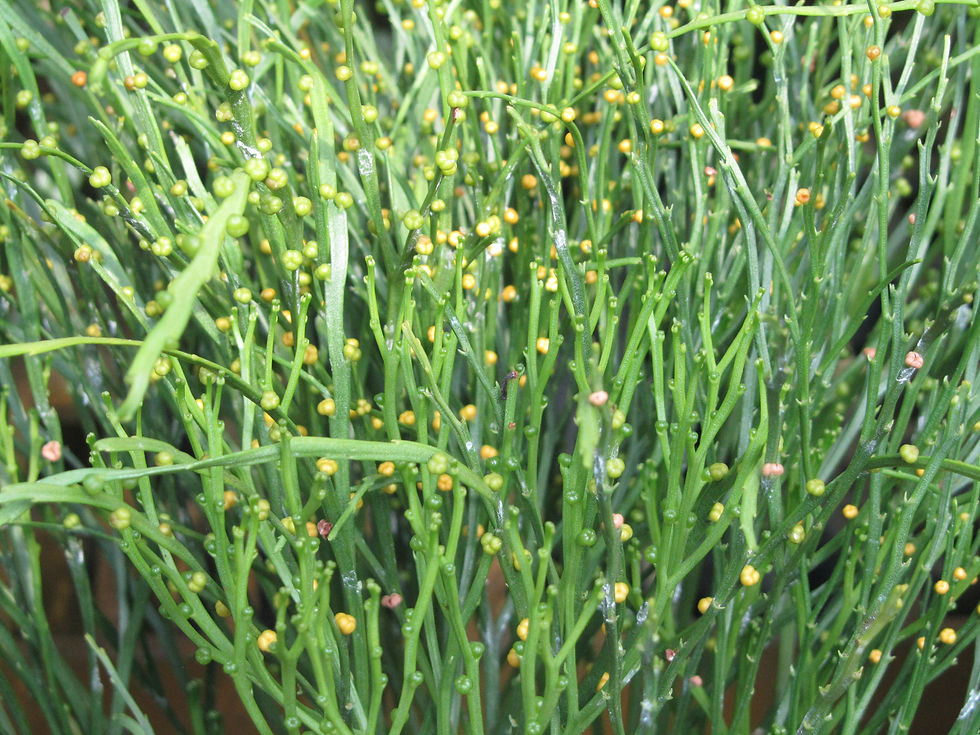
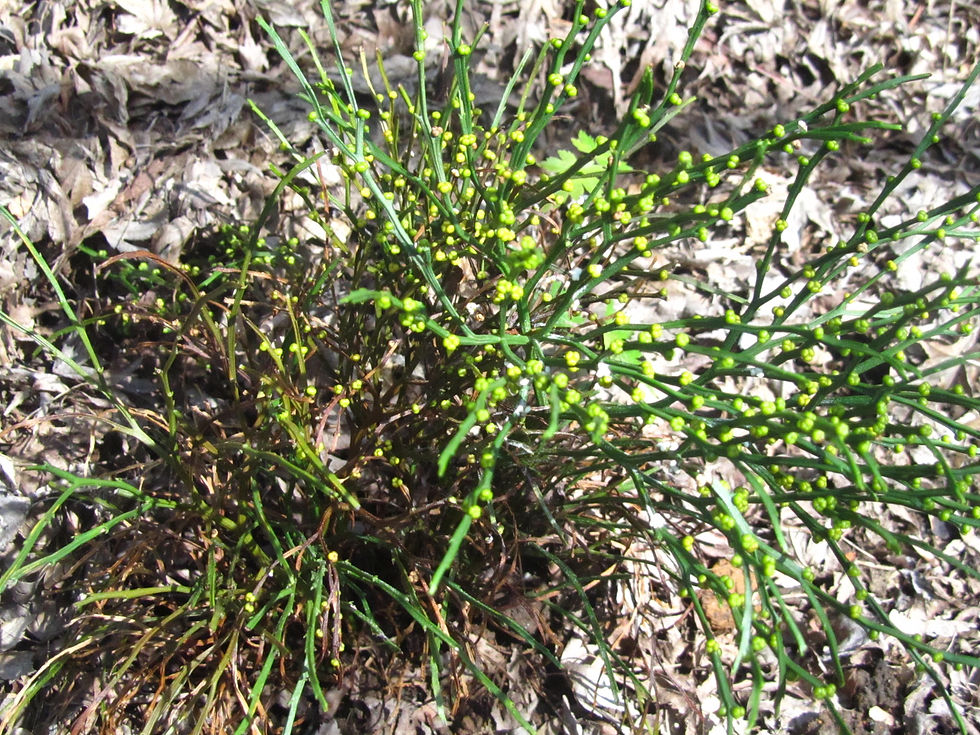
Psilotum nudum has creeping brown rhizomes to anchor themselves, usually to a tree or a rock. Stems are upright but can droop slightly. They are green with many white stomata. The stems are 15 to 50 cm wide but relatively thin, only about 1 mm; they are smooth, ridged, and branch out. Along the stems are leaf-like structures called tropophylls; they are narrowly triangular and 1 to 2 mm long. Also along the stems are tiny joint-like structures called sporangia that hold the spores. These are yellowish and are roughly spherical, 3 to 4 mm wide, and 3-lobed (occasionally 2-lobed). The sporophylls, often just under the sporangia, are 2 to 3 mm long and are two-pronged (Wu et al. 2013).
It is similar to the only other species in its genus, Psilotum complanatum. However, Psilotum complanatum has flattened stems (Tryon and Hodge 1982).
It is similar to the only other species in its genus, Psilotum complanatum. However, Psilotum complanatum has flattened stems (Tryon and Hodge 1982).
Uses
Note: Please see the disclaimer regarding any information about medical or edible uses.
Psilotum nudum is sometimes cultivated as a garden plant, especially in Japan, where over a hundred cultivars were developed and it was considered sacred during the 17th century (Christenhusz et al. 26). It grows in USDA zones 8 to 11 (Morse). In Hawaii and Polynesia, its spores were used to prevent chafing when applied under loincloths (Christenhusz et al. 2017).
Distribution
Psilotum nudum can be epiphytic and can attach to trees, or rock crevices. It grows at an altitude of below 1000 m. It is found in most tropical and subtropical regions of the world (Wu et al. 2013), as long as they are not dry (Christenhusz et al. 2017).
Status
References
Christenhusz, M. J., Fay, M. F., and Chase, M. W. 2017. Plants of the world: An illustrated encyclopedia of vascular plants. Chicago: University of Chicago Press.
Morse, C. Psilotum nudum. EEB Biodiversity Education & Research Greenhouses. http://florawww.eeb.uconn.edu/198500935.html
Smith, A. R., Pryer, K. M., Schuettpelz, E., Korall, P., Schneider, H., and Wolf, P. G. 2006. A classification for extant ferns. Taxon, 55(3): 705-731.
Tryon, R. M., and Hodge, W. H. (1982). Ferns and allied plants: With special reference to tropical America. New York: Springer-Verlag.
Wu, Z. Y., Raven, P. H., and Hong, D. Y., eds. 2013. Flora of China. Vol. 2-3 (Lycopodiaceae through Polypodiaceae). Beijing: Science Press, and St. Louis: Missouri Botanical Garden Press.
Morse, C. Psilotum nudum. EEB Biodiversity Education & Research Greenhouses. http://florawww.eeb.uconn.edu/198500935.html
Smith, A. R., Pryer, K. M., Schuettpelz, E., Korall, P., Schneider, H., and Wolf, P. G. 2006. A classification for extant ferns. Taxon, 55(3): 705-731.
Tryon, R. M., and Hodge, W. H. (1982). Ferns and allied plants: With special reference to tropical America. New York: Springer-Verlag.
Wu, Z. Y., Raven, P. H., and Hong, D. Y., eds. 2013. Flora of China. Vol. 2-3 (Lycopodiaceae through Polypodiaceae). Beijing: Science Press, and St. Louis: Missouri Botanical Garden Press.
Description
bottom of page