top of page
Pinus thunbergii
Parl.
Japanese Black Pine
Pinaceae
Pinus thunbergii is a coniferous tree in the family Pinaceae. It is native to the coastal Japan and South Korea, and is cultivated and naturalized elsewhere.
Description
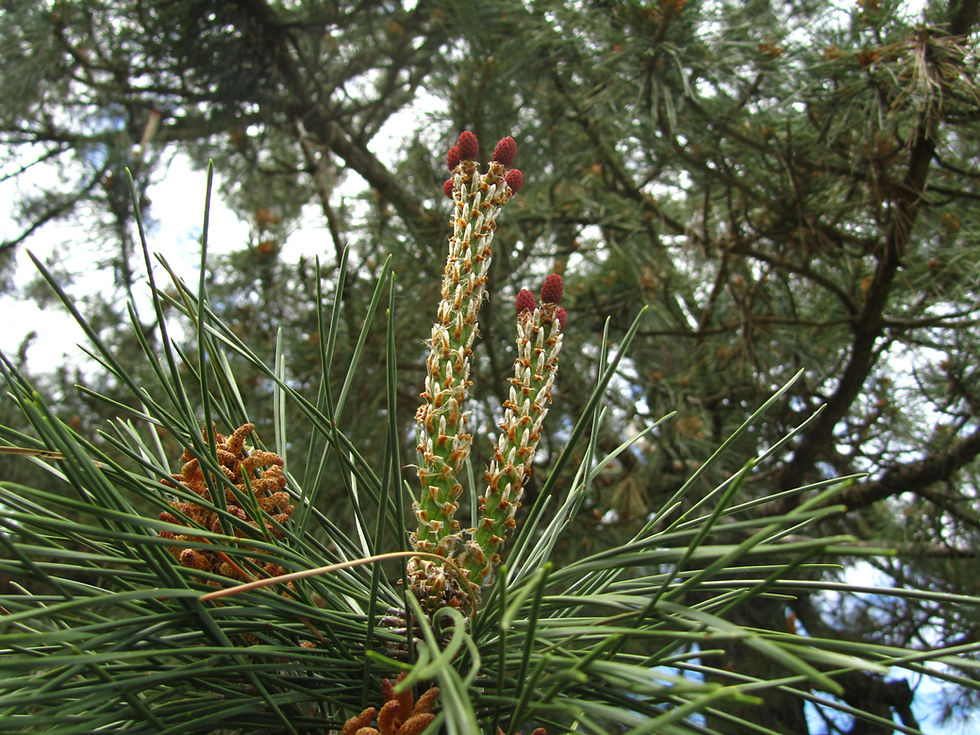
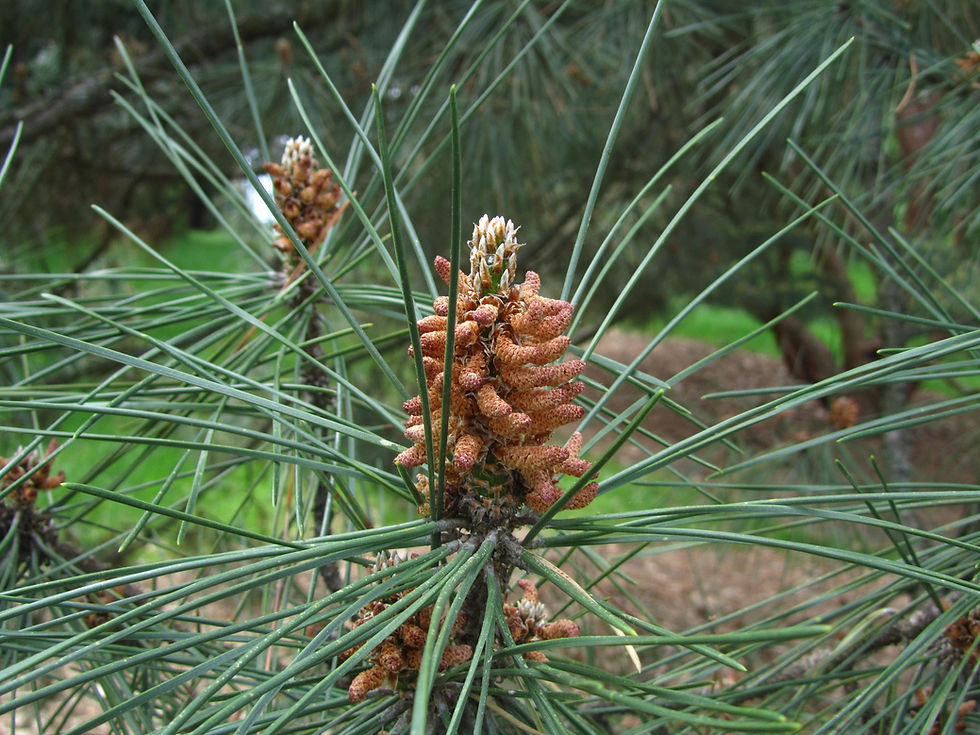
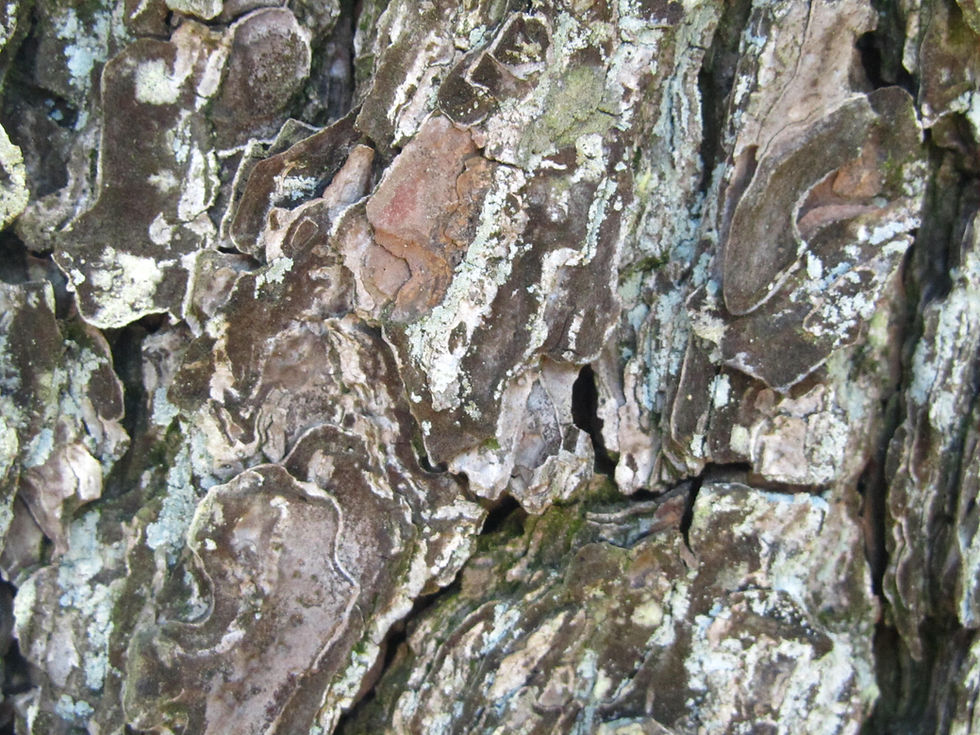
Pinus thunbergii is a medium-sized tree, growing up to around 30 m with a trunk that grows 1 or occasionally up to 2 m wide. Conical when young, it forms a flat-topped crown with horizontal to upswept branches. Needles are stiff and straight, around 9 to 12 cm in bundles of 2, occasionally 3. They are dark green with inconspicuous bands (which are stomata) on both sides of the leaves, and they persist on the tree for 3, sometimes 4 years. Sheaths are 6 to 10 mm long, and are persistent. Buds are typically 1.5 to 2.5 mm long, and are not resinous. The bark is dark gray with reddish gray flakes, narrowly furrowed into flat, irregular plates. Twigs are yellowish brown and are hairless. Pollen cones are 10 to 13 mm, densely clustered and yellowish brown. Seed cones are 4.5 to 6 cm long, egg-shaped to round, and shortly stalked. They are grayish green, ripening to yellowish brown. Cones have around 50 to 60 scales that are spoon-shaped, with a diamond-shaped or pentagonal face, with a horizontal ridge tipped with a tiny prickle. These cones open widely to release their seeds and fall from the tree. Seeds are typically 3.5 to 6 mm long, with an easily detachable wing that is 10 to 15 mm long (Eckenwalder 2009).
Uses
Note: Please see the disclaimer regarding any information about medical or edible uses.
Pinus thunbergii is commonly cultivated as an ornamental or (MBG), especially in Japan where it is the second most commonly cultivated conifer after Cryptomeria japonica. Despite growing naturally in salt spray, the tree grows best in sheltered sites (Eckenwalder 2009). It prefers fertile and well-drained soils, medium moisture, and full sun. It is tolerant of shade. It grows in USDA zones 5 to 8 (MBG). However, it is susceptible to pests and diseases, and is mostly found in parks and arboreta, where they are solitary so they do not become infested (Farjon 2013).
Distribution
As a lumber tree, Pinus thunbergii is used similarly to Pinus nigra, and has a wide variety of construction uses (Farjon 2013).
Status
Pinus thunbergii is common on coastal hills and mountains, up to 1000 m. Previously it would have grown alongside deciduous angiosperms and occasionally other conifers, but cultivation has shifted its distribution towards the coast, as it is tolerant of salt and wind. It is native to the coasts of Japan (from southern Hokkaido to Kyushu) and South Korea (Farjon 2013). It has locally escaped in eastern North America (Kartesz 2015).
References
Pinus thunbergii is listed on the IUCN Red List as "Least Concern", as it has a very wide range. Some potential threats include local logging and urban development (Farjon 2013).
References
Eckenwalder, J. E. 2009. Conifers of the world: the complete reference. Portland: Timber Press.
Farjon, A. 2013. Pinus thunbergii. The IUCN Red List of Threatened Species. http://dx.doi.org/10.2305/IUCN.UK.2013-1.RLTS.T42423A2979140.en.
Kartesz, J. T., The Biota of North America Program (BONAP). 2015. North American Plant Atlas. (http://bonap.net/napa). Chapel Hill, N.C. [maps generated from Kartesz, J.T. 2015. Floristic Synthesis of North America, Version 1.0. Biota of North America Program (BONAP). (in press)].
MBG (Missouri Botanical Garden), Pinus thunbergii. Plant Finder. [accessed 2019 Sep 06]. http://www.missouribotanicalgarden.org/PlantFinder/PlantFinderDetails.aspx?kempercode=b438
Eckenwalder, J. E. 2009. Conifers of the world: the complete reference. Portland: Timber Press.
Farjon, A. 2013. Pinus thunbergii. The IUCN Red List of Threatened Species. http://dx.doi.org/10.2305/IUCN.UK.2013-1.RLTS.T42423A2979140.en.
Kartesz, J. T., The Biota of North America Program (BONAP). 2015. North American Plant Atlas. (http://bonap.net/napa). Chapel Hill, N.C. [maps generated from Kartesz, J.T. 2015. Floristic Synthesis of North America, Version 1.0. Biota of North America Program (BONAP). (in press)].
MBG (Missouri Botanical Garden), Pinus thunbergii. Plant Finder. [accessed 2019 Sep 06]. http://www.missouribotanicalgarden.org/PlantFinder/PlantFinderDetails.aspx?kempercode=b438
Description
bottom of page