top of page
Pinus edulis
Engelm.
Colorado Pinyon
Pinaceae
Pinus edulis is a coniferous tree in the family Pinaceae. It is native to dry areas in the southwestern United States, and has edible seeds.


Description
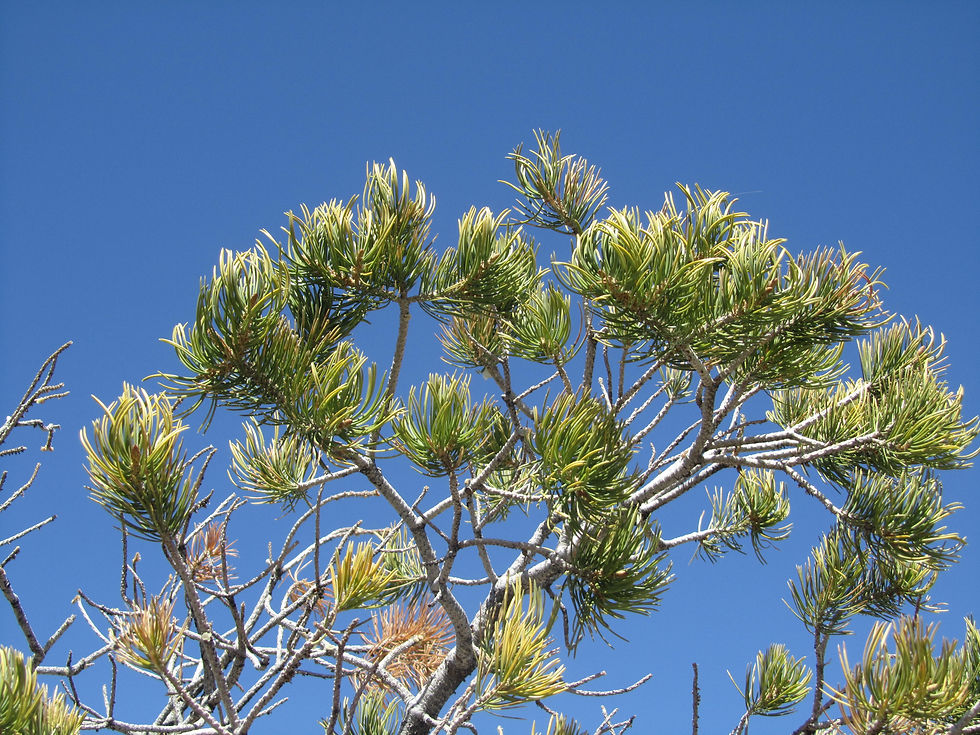
Pinus edulis is a small tree, growing up to 10 to 20 m with a trunk that grows up to 0.6 to 1.7 m wide. It forms an egg-shaped crown when young, becoming broader with age. Branches are numerous and tend to grow upwards. Needles are slightly curved, stiff, and often stuck together, typically 2 to 4.5 cm in bundles of 2, but sometimes 1 or 3. They are bright light green to blue-green with pale bands (which are stomata) on both the inner and outer sides of the leaves, and they persist on the tree for 4 to 9 years. Sheaths are 5 to 7 cm long, curling back, and are not persistent. Buds are 5 to 10 mm long, and are resinous. The bark is light brown, becoming shallowly furrowed with irregularly and small plates. Twigs are light reddish brown becoming light gray and are hairless. Pollen cones are 7 to 10 mm, yellowish brown. Seed cones are typically 4 to 5 cm long, roughly spherical, and shortly stalked at most. They are green, ripening to yellowish brown. Seed scales are oblong, very thick, with a pyramid-shaped face and a diamond-shaped tip, called an umbo. These cones open widely to release their seeds and fall from the tree. Seeds are 10 to 15 mm long, wingless (Eckenwalder 2009).
Pinus edulis is part of a group of similar species called pinyon pines. The species are similar and hybridize with each other, and their taxonomic statuses are unclear (Eckenwalder 2009).
Pinus edulis is part of a group of similar species called pinyon pines. The species are similar and hybridize with each other, and their taxonomic statuses are unclear (Eckenwalder 2009).
Uses
Note: Please see the disclaimer regarding any information about medical or edible uses.
Pinus edulis is mainly used for its high-quality firewood, and its edible seeds are collected and eaten. Young trees are also used locally as Christmas trees (Farjon 2013).
Distribution
Pinus edulis is native to the southwestern United States in southern California, Arizona, New Mexico, northwestern Texas, Utah, Colorado, southern Wyoming, and western Oklahoma. It is most common in the so-called “Four Corner” States. There, it is found alongside junipers (most commonly Juniperus monosperma and Juniperus osteosperma) in rocky areas such as interior basins, plateaus, mesas, and mountains (Farjon 2013).
Status
Pinus edulis is listed on the IUCN Red List as "Least Concern", as the species is very widespread. However, the pinyon-juniper woodland habitat has been converted to pastures for cattle and sheep, and many trees have died from drought and pine bark beetles (Farjon 2013).
References
Eckenwalder, J. E. 2009. Conifers of the world: the complete reference. Portland: Timber Press.
Farjon, A. 2013. Pinus edulis. The IUCN Red List of Threatened Species. http://dx.doi.org/10.2305/IUCN.UK.2013-1.RLTS.T42360A2975133.en.
Farjon, A. 2013. Pinus edulis. The IUCN Red List of Threatened Species. http://dx.doi.org/10.2305/IUCN.UK.2013-1.RLTS.T42360A2975133.en.
Description
bottom of page