Description
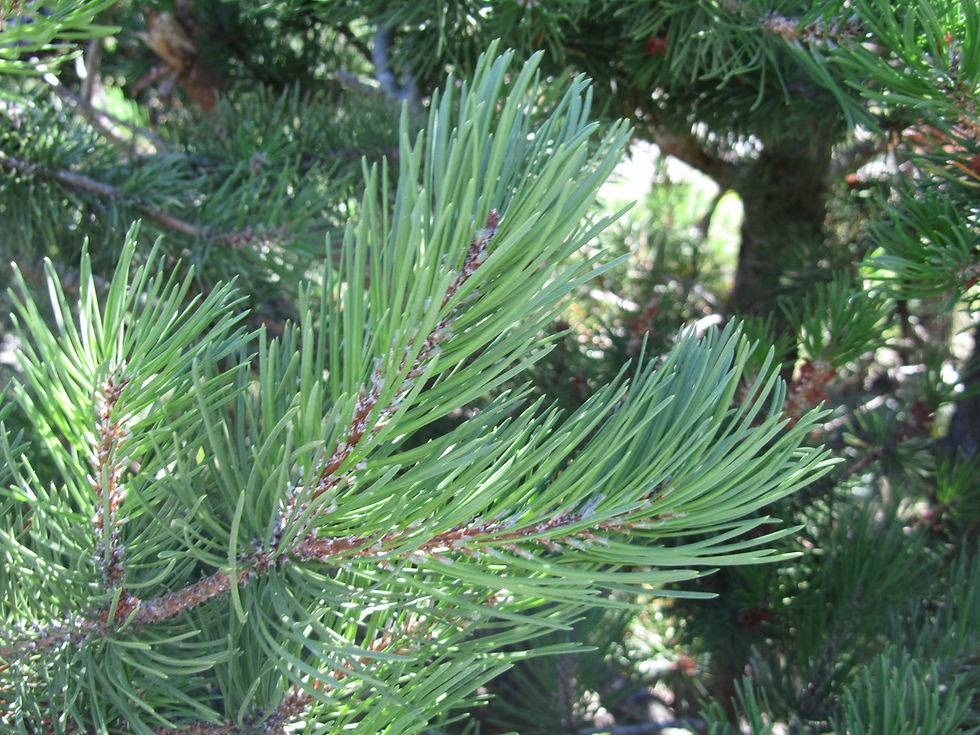
Pinus contorta is a tree, although its stature varies, growing anywhere from 10 cm to 50 m with a trunk that grows up to 1 or 2 m wide. It forms a narrowly conical crown when in dense stands, but is open and irregular alone. Needles are stiff and sometimes twisted, anywhere from 2 to 8 cm in bundles of 2. They are dark green to yellowish green, and they persist on the tree for 3 to 5 but sometimes up to 8 years. Sheaths are 3 to 6 mm long. Buds are 12 to 15 mm long, and are slightly resinous. The bark is pale reddish brown, gray, or dark brown, variously scaly or ridged and furrowed. Twigs are yellowish brown to reddish brown and are hairless. Pollen cones are 5 to 15 mm, yellowish and slightly reddish brown. Seed cones are 2 to 6 cm long, egg-shaped and sometimes asymmetrical. They are green, ripening to orangish brown. Cones have at least 75 to 90 scales that are paddle-shaped, stiff. The exposed face is diamond-shaped and pyramidal with a diamond-shaped umbo and a 6 mm long prickle. These cones open after maturity, sometimes only in the event of a fire, at which point it releases its seeds to release their seeds. Seeds are 3 to 5 mm long, partially or completely black, with an easily detachable wing that is 10 to 12 mm long (Eckenwalder 2009).
The three varieties vary in size and details of needles and cones. Variety contorta is shrubby and often twisted, hence its name. It has needles that are around 2 to 6 cm long, furrowed and ridged bark. Its cones are asymmetric, curved backwards on the tree and opening after maturity, staying on the tree. Variety latifolia is tall and narrow. It has scaly bark, yellowish green needles around 5 to 8 cm long, and asymmetric cones that are curved backwards and closed after maturity. Variety murrayana is also tall and straight. It is similar to var. latifolia but its cones are more symmetrical, stick out from the twig, open after maturity and shortly fall off (Eckenwalder 2009).
Uses
Note: Please see the disclaimer regarding any information about medical or edible uses.
The taller, straighter varieties (var. latifolia and murrayana) are important timber trees. Traditionally they were used as “lodgepoles”: tall, straight trunks that grew close together were harvested and used as tent poles by the Dakota and Blackfeet. It is also used for pulpwood.
Indigenous people have used the inner bark as a food source, the needles were steeped to make a tea, and the resin, known as pitch, was used to treat sore throats, muscle pains, and rheumatic pains (UCANR).
Distribution
The three species occupy different areas. Variety contorta is found in coastal cloud forests, bogs, and dry foothills at altitudes of up to 600 m. It is native from the Alaska Panhandle south to northwestern California. Variety latifolia is found in mountainous forests up to 3500 m. It is native to Yukon Territory, southwestern Northwest Territory, southeastern Alaska, British Columbia, Alberta, southwestern Saskatchewan, Washington, Idaho, Montana, Oregon, Wyoming, Utah, Colorado, and southwestern South Dakota. Variety murrayana is found in mountainous forests from 400 to 3500 m; it is native to inland southern Washington, Oregon, California, western Nevada, and Baja California in Mexico (FNAEC 1993).
Pinus contorta has been introduced as a timber tree in the Americas, Europe, and Oceania, but that has also caused it to become invasive in southern South America and New Zealand (Cobar 2014).
Status
Pinus contorta is listed on the IUCN Red List as "Least Concern", since it has a very wide distribution. Some minor threats include bark beetles and changes to the fire regime. All of its varieties are also considered to be safe from threats as well (Farjon 2013).
References
Cobar, A. J. 2014. Pinus contorta (lodgepole pine). <i>Invasive Species Compendium</i>. <a>www.cabi.org/isc/datasheet/41577</a><br><br>Eckenwalder, J. E. 2009. <i>Conifers of the world: the complete reference</i>. Portland: Timber Press.<br><br>FNAEC (Flora of North America Editorial Committee), editor. 1993. <i>Flora of North America, north of Mexico. Volume 2: Pteridophytes and Gymnosperms</i>. New York: Oxford University Press.<br><br>UCANR (University of California Agriculture and Natural Resources). Lodgepole pine (Pinus contorta). Forest Research and Outreach. [accessed 2019 Oct 1]. <a>https://ucanr.edu/sites/forestry/California_forests/http___ucanrorg_sites_forestry_California_forests_Tree_Identification_/Lodgepole_pine_Pinus_contorta/</a>