top of page
Pinus albicaulis
Engelm.
Whitebark Pine
Pinaceae
Pinus albicaulis is a coniferous tree in the family Pinaceae. It is native to mountainous areas of western North America.


Description
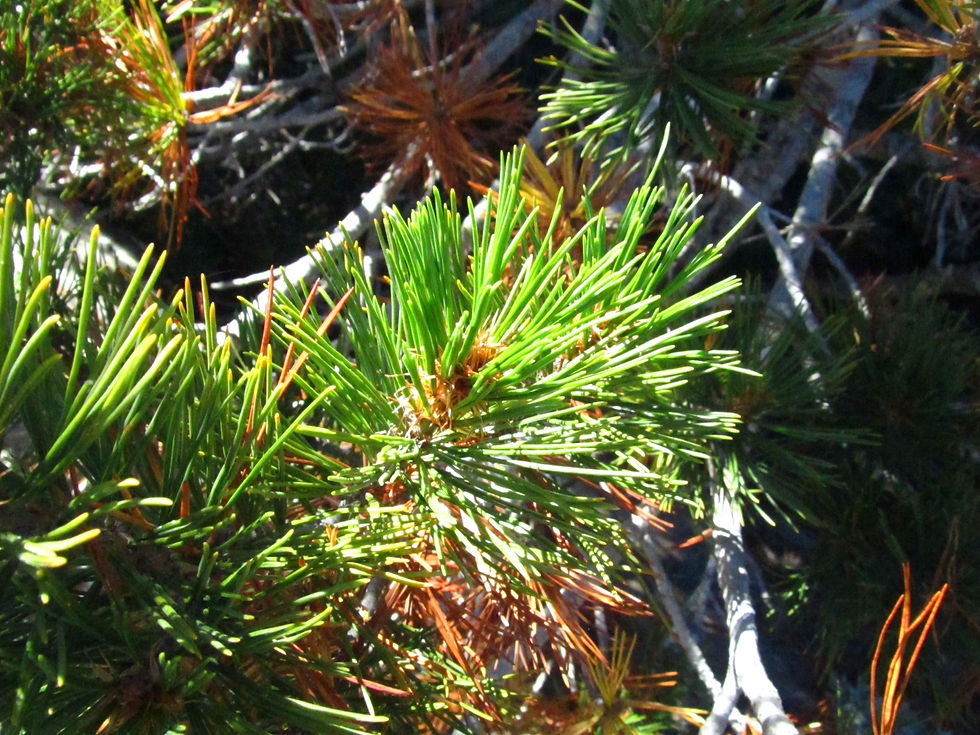
Pinus albicaulis is a small to medium tree, becoming a shrub at the tree line, growing up to 20 m with a trunk that grows 1.5 or occasionally 2.5 m wide. It forms an oval to rounded crown. Branches are slender, horizontal to upswept. Needles are stiff, typically 4 to 7 cm in bundles of 5. They are dark yellowish green with pale bands (which are stomata) on all three faces sides of the leaves, and they persist on the tree for 4 to 8 years. Sheaths are 8 to 12 mm long, and are not persistent. Buds are 5 to 10 mm long, and are not resinous. The bark is pale gray at first, becoming darker and more blocky with age. Twigs are reddish brown and hairy, becoming gray and hairless. Pollen cones are 10 to 15 mm, red. Seed cones are around 5 to 8 cm long, egg-shaped to round, and unstalked or with a very short stalk. They are purplish green, ripening to purplish brown to black. Cones have around 30 to 60 scales that are wedge-shaped, thick, with a conspicuous triangular tip, called an umbo. These cones stay closed on the tree and are often open by other animals. Seeds are 7 to 11 mm long, egg-shaped, wingless (Eckenwalder 2009).
Uses
Note: Please see the disclaimer regarding any information about medical or edible uses.
In the past, Pinus albicaulis was once widely cut down for timber (Mahalovich and Stritch 2013). It can be cultivated, but it is typically valued for its aesthetics in its natural habitat, as well as protecting watersheds by reducing erosion and slowing down runoff. The seeds are edible, and highly nutritious (Fryer 2002).
Distribution
Pinus albicaulis is found in mountainous, rocky areas; it forms sparse, pure stands or may be mixed with other coniferous trees, such as subalpine fir (Abies lasiocarpa), Engelmann spruce (Picea engelmannii), and mountain hemlock (Tsuga mertensiana). It grows typically at elevations of 1500 to 3500 m, but sometimes lower or higher. It is native to British Columbia, Alberta, Washington, Idaho, Montana, Oregon, Wyoming, California, and Nevada (Eckenwalder 2009; Mahalovich and Stritch 2013).
Status
Pinus albicaulis is listed on the IUCN Red List as "Endangered". The main decline is due to white pine blister rust (Cronartium ribicola), and more recently, mountain pine beetle (Dendroctonus ponderosae). These two threats are exacerbated by climate change, which weakens the trees and makes forest fires and droughts worse. Additionally, there is some research that suggests that Clark's nutcracker (Nucifraga columbiana), the main seed disperser for this species, will stop visiting the trees and thus stop distributing the seeds once a certain number of trees in an area die (Mahalovich and Stritch 2013).
References
Eckenwalder, J. E. 2009. Conifers of the world: the complete reference. Portland: Timber Press.
Fryer, J. L. 2002. Pinus albicaulis. Fire Effects Information System. [accessed 2019 Aug 25]. https://www.fs.fed.us/database/feis/plants/tree/pinalb/all.html.
Mahalovich, M., and Stritch, L. 2013. Pinus albicaulis. The IUCN Red List of Threatened Species. http://dx.doi.org/10.2305/IUCN.UK.2013-1.RLTS.T39049A2885918.en.
Fryer, J. L. 2002. Pinus albicaulis. Fire Effects Information System. [accessed 2019 Aug 25]. https://www.fs.fed.us/database/feis/plants/tree/pinalb/all.html.
Mahalovich, M., and Stritch, L. 2013. Pinus albicaulis. The IUCN Red List of Threatened Species. http://dx.doi.org/10.2305/IUCN.UK.2013-1.RLTS.T39049A2885918.en.
Description
bottom of page