top of page
Picea rubens
Sarg.
Red Spruce
Pinaceae
Picea rubens is a coniferous tree species in the family Pinaceae. It is native to northeastern North America to the Appalachians, being cut down extensively in the past. It is the provincial tree of Nova Scotia (FNAEC 1993).


Description
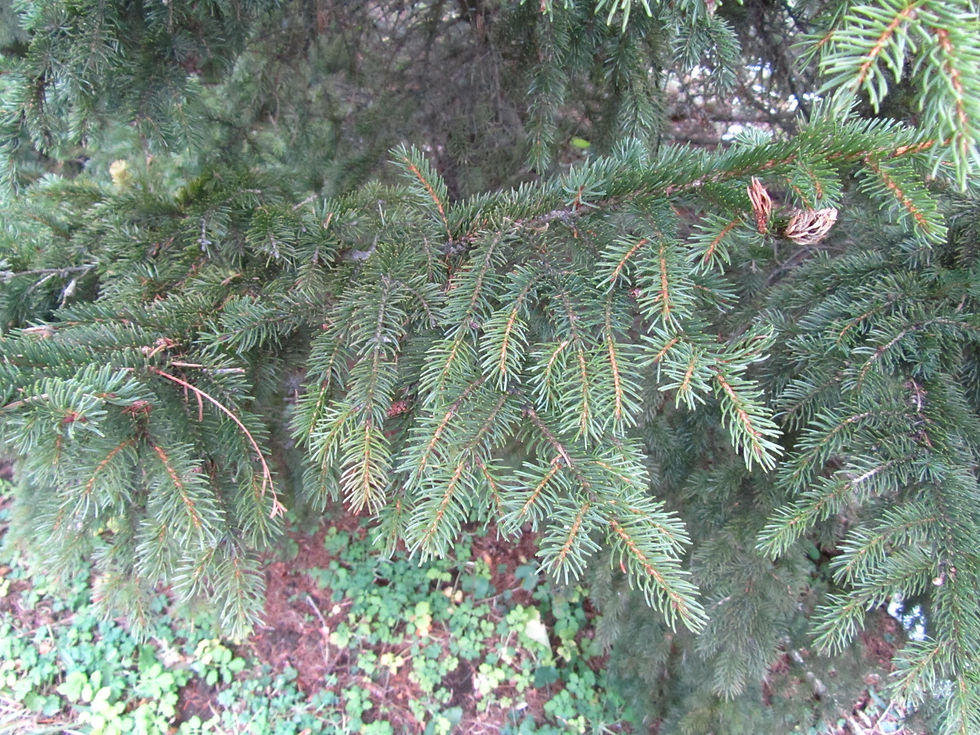
Picea rubens is a medium to tall tree, growing up to 40 m tall with a trunk that grows 1 to 1.5 m in diameter, forming a conical crown. Branches are long, horizontal to ascending, with horizontal or somewhat drooping branchlets. Needles are stiff, typically 1 to 1.6 cm long, square in cross section with a pointed tip. They are yellowish to dark green with two to four whitish bands (which are stomata) on all sides of the needles. As with other species in the genus Picea, the needles are attached to the twig via a woody "peg" that persists after the needle has fallen. Buds are 5 to 8 mm long, and are not conspicuously resinous. The bark is reddish to grayish brown, irregularly ridged and furrowed. Twigs are yellowish brown and are hairy, particularly in the grooves. Pollen cones are 1.5 to 2.5 cm, red. Seed cones are around 2.3 to 4.5 cm long, hanging down from the branchlets. They are green or purplish green, ripening to brown. The cone scales are thin, broadly egg-shaped, woody, stiff and brittle in texture. Seeds are 2 to 3.5 mm long, with a wing that is 4 to 8 mm long (Eckenwalder 2009).
Picea rubens is similar to white spruce (Picea glauca), but that species has hairless twigs and somewhat longer cones. It is more similar to black spruce (Picea mariana), but the cones of that species are typically shorter, around 2 to 3 cm long, and the needles are somewhat shorter, blunt-tipped, and glaucous (with a bluish-gray cast) (FNAEC 1993). The habitat is also quite different: Picea rubens is tolerant of shade and grows with hardwood species, while Picea mariana requires light and is mostly a pioneer species of bogs (Eckenwalder 2009).
Picea rubens is similar to white spruce (Picea glauca), but that species has hairless twigs and somewhat longer cones. It is more similar to black spruce (Picea mariana), but the cones of that species are typically shorter, around 2 to 3 cm long, and the needles are somewhat shorter, blunt-tipped, and glaucous (with a bluish-gray cast) (FNAEC 1993). The habitat is also quite different: Picea rubens is tolerant of shade and grows with hardwood species, while Picea mariana requires light and is mostly a pioneer species of bogs (Eckenwalder 2009).
Uses
Note: Please see the disclaimer regarding any information about medical or edible uses.
Species of spruce, including Picea rubens, are important timber trees. Their wood is often used for construction, and particularly musical instruments. It is rarely cultivated. In the past, the resin has been used as chewing gum (Farjon 2013). A drink called spruce beer can be made by boiling the needles and branchlets, then adding sugar (Little 1980).
Distribution
Picea rubens grows mixed with hardwood trees as isolated trees or small clumps in the north. In the south of its range, it is more restricted to montane forests and is dominant or mixed with Fraser fir (Abies fraseri). It grows at elevations of up to 1500 m, sometimes 2000 m (Eckenwalder 2009). It is native to southeastern Ontario, southern Quebec, New Brunswick, Nova Scotia, St. Pierre and Miquelon, and Prince Edwards Islands of Canada; in the United States it is native to Maine, New Hampshire, Vermont, Massachusetts, Connecticut, New York, New Jersey, Maryland, Pennsylvania, Virginia, West Virginia, and North Carolina. In the last few states it is scattered and restricted to the Appalachian Mountains (FNAEC 1993).
Status
Picea rubens is listed on the IUCN Red List as “Least Concern”. In the 19th and 20th centuries, this tree was logged extensively for timber, and its habitat was cleared for agriculture, causing a decline in the population. However, currently it does not appear to be declining in its range. Acid rain and atmospheric pollution are more recent threats (Farjon 2013).
References
Eckenwalder, J. E. 2009. Conifers of the world: the complete reference. Portland: Timber Press.
Farjon, A. 2013. Picea rubens. The IUCN Red List of Threatened Species. https://dx.doi.org/10.2305/IUCN.UK.2013-1.RLTS.T42335A2973542.en.
FNAEC (Flora of North America Editorial Committee), editor. 1993. Flora of North America, north of Mexico. Volume 2: Pteridophytes and Gymnosperms. New York: Oxford University Press.
Little, E. L. 1980. National Audubon Society Field Guide to North American Trees: Eastern Region. New York: Alfred A. Knopf.
Farjon, A. 2013. Picea rubens. The IUCN Red List of Threatened Species. https://dx.doi.org/10.2305/IUCN.UK.2013-1.RLTS.T42335A2973542.en.
FNAEC (Flora of North America Editorial Committee), editor. 1993. Flora of North America, north of Mexico. Volume 2: Pteridophytes and Gymnosperms. New York: Oxford University Press.
Little, E. L. 1980. National Audubon Society Field Guide to North American Trees: Eastern Region. New York: Alfred A. Knopf.
Description
bottom of page