top of page
Lepisorus thunbergianus
(Kaulf.) Ching
Weeping Fern
Polypodiaceae
Lepisorus thunbergianus is a species of fern in the family Polypodiaceae. It is widespread over eastern Asia.
Description
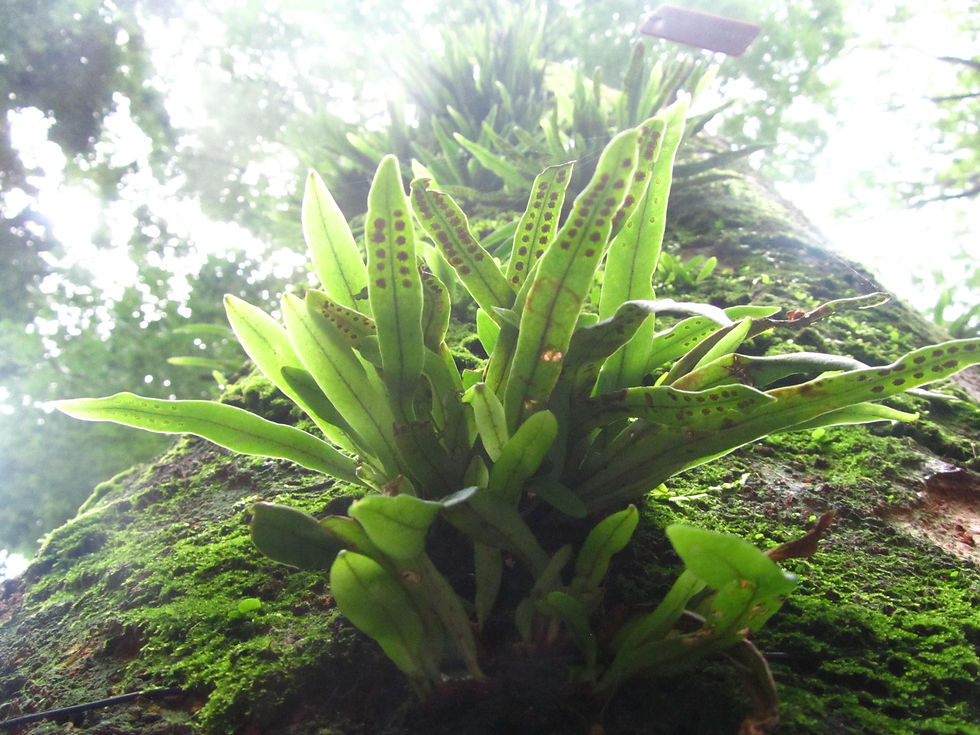
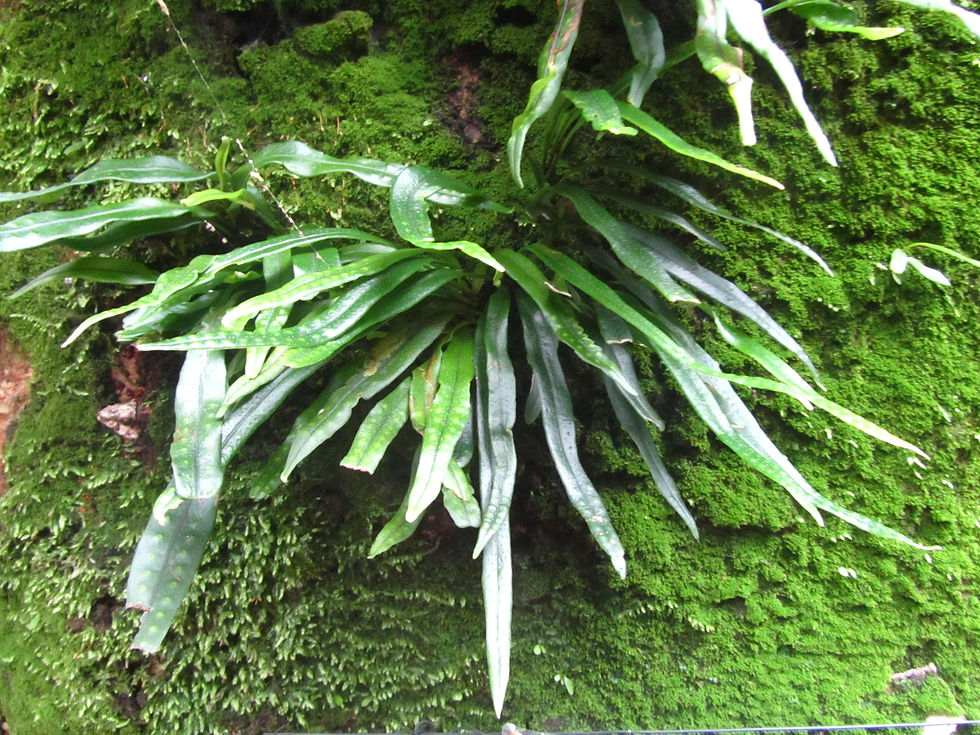
Lepisorus thunbergianus is a small plant, spreading by rhizomes. Rhizomes are covered with brown lanceolate scales when young. The scales are 2 to 4 mm wide and 0.4 to 1 mm wide and finely toothed. Fronds are narrowly lanceolate or linear, 10 to 18 cm long and 0.5 to 1.3 cm wide, pale green. They are leathery, tapered at the base and sharply pointed near the tip; the midrib is raised on both sides. Sori are found closer to the tip of the leaf. They are round, 1.5 to 3 mm wide, and borne in two rows along the midrib (Wu et al. 2013).
Uses
Note: Please see the disclaimer regarding any information about medical or edible uses.
Lepisorus thunbergianus is a common weed, but is also used medicinally or as an ornamental plant (Xu et al. 90).
Distribution
This plant is grows on trees or rocks in forests, at an altitude of up to 2000 m. It is common in eastern Asia, and it is native to Japan, Korea, China, Taiwan, Nepal, northeastern India, and the Philippines (Wu et al. 2013).
Status
References
Wu, Z. Y., Raven, P. H., and Hong, D. Y., eds. 2013. Flora of China. Vol. 2-3 (Lycopodiaceae through Polypodiaceae). Beijing: Science Press, and St. Louis: Missouri Botanical Garden Press.
Xu, Z., and Deng, M. 2017. Identification and Control of Common Weeds, Volume 2. Berlin: Springer.
Xu, Z., and Deng, M. 2017. Identification and Control of Common Weeds, Volume 2. Berlin: Springer.
Description
bottom of page