top of page
Hemionitis windhamii
(D.M.Benham) Christenh.
(no common name)
Pteridaceae
Hemionitis windhamii is a species of fern in the family Pteridaceae. It is native to rocky areas in the southwestern United States and northern Mexico.

Description
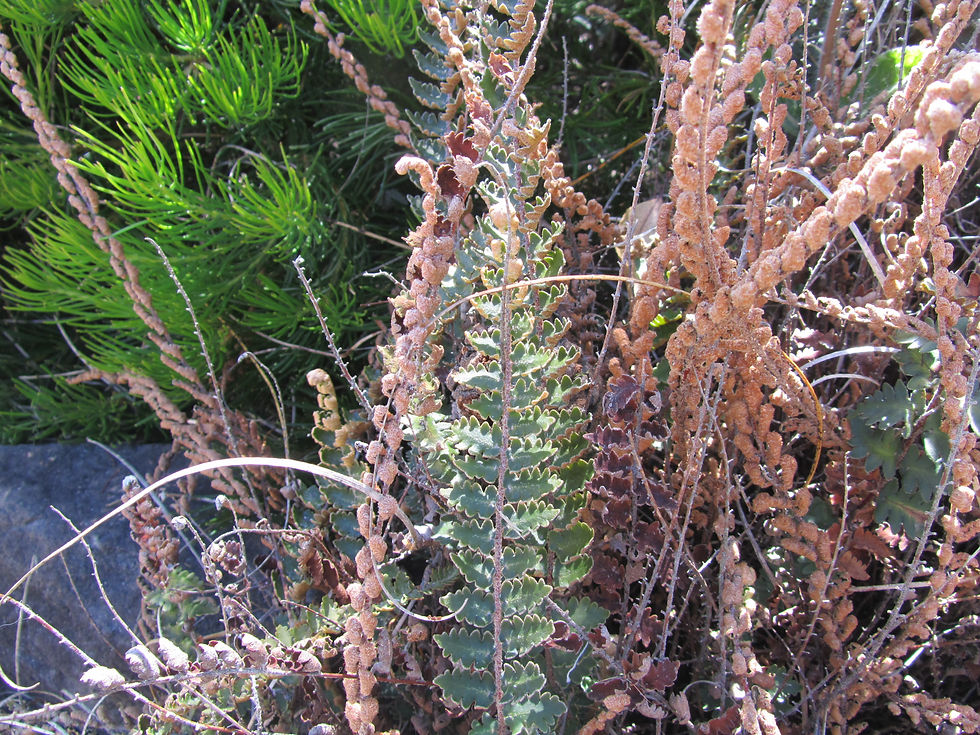
Hemionitis windhamii is a short, somewhat creeping fern that usually grows on rock. It is covered in tan scales that are up to 15 mm long with smooth, hairy or toothed edges. Leaves are 10 to 50 cm long, linear to linear-oblong, between pinnate and bipinnate, with about 20 to 45 pairs of leaflets, called pinnae. These pinnae are ovate to deltate, 7 to 15 mm at their largest, symmetrically lobed with about 6 to 11 rounded lobes. The lower side is covered with hairy lanceolate scales that are 1 to 1.5 mm, while the upper side has sparse tiny star-shaped scales, that are about 2 to 4 cells wide. Sporangia are found on the lower sides of leaflets, near the margins, and contain 32 spores (FNAEC 1993).
The species is sometimes lumped into Hemionitis integerrima, but differs in having asymmetrically lobed or unlobed leaflets that are densely scaly on the upper side. Genetic studies indicate Hemionitis windhamii to be a hybrid of three different species (FNAEC 1993).
The species is sometimes lumped into Hemionitis integerrima, but differs in having asymmetrically lobed or unlobed leaflets that are densely scaly on the upper side. Genetic studies indicate Hemionitis windhamii to be a hybrid of three different species (FNAEC 1993).
Uses
Note: Please see the disclaimer regarding any information about medical or edible uses.
Distribution
Hemionitis windhamii is found on rocky hillsides and cliffs, which may be calcareous (rich in calcium carbonate), at altitudes of 1200 to 2100 m. It is found in central to southern Arizona, New Mexico, southwestern Texas, and northern Mexico (FNAEC 1993).
Status
References
FNAEC (Flora of North America Editorial Committee), editor. 1993. Flora of North America, north of Mexico. Volume 2: Pteridophytes and Gymnosperms. New York: Oxford University Press.
Description
bottom of page