top of page
Euptelea polyandra
Siebold & Zucc.
(no common name)
Eupteleaceae
Euptelea polyandra is a deciduous tree species in the family Eupteleaceae. It is native to central and southern Japan.


Description
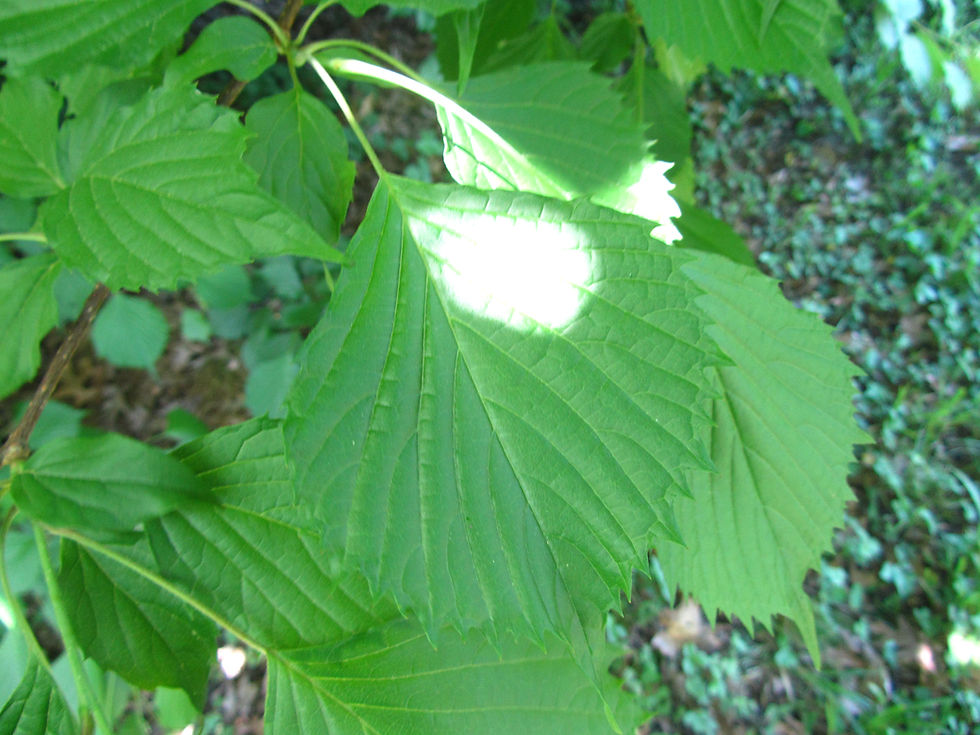
Euptelea polyandra is a deciduous tree growing up to 15 m. Leaves are alternate, the blade about 6 to 12 cm long and wide on a slender petiole about 3 to 7 cm wide, hairy on the upper side while young. They are mostly round in outline, pinnately nerved, with irregular coarse teeth; the tip is abruptly narrow and long-pointed. Leaves lack stipules. The bark is grayish, often rough and with lenticels. Flowers are produced in clusters before the leaves, and are rather small, on short pedicels (stalks), without petals or sepals. Flowers have around 8 to 18 hanging stamens and red anthers 6 to 7 mm long, and 8 to 18 pale green pistils each with 1 to 4 carpels and a broadly linear stigma. The flowers mature into fruit, which are samaras containing one seed. They are obovate in outline, glabrous, 5 to 7 mm long, tapering at the base into the pedicel. At maturity, they ripen to become pale yellowish tan. The seeds are about 2 to 2.5 mm long (Hishiyama 2010; Ohwi et al. 1965; Smith 1946).
Euptelea polyandra is one of two species of the unusual genus Euptelea, a Tertiary relict, which itself is the only genus in the family Eupteleaceae. It is estimated that some 100 million years ago, the ancestors of this genus split off from the rest of the Ranunculales, but did not split into two species until about 5 million years ago in the late Miocene (Cao et al. 2016). The other species is Euptelea pleiosperma, native to China and India, is similar but usually has more than one seed per fruit, and the leaves are more regularly toothed with the terminal tip being usually 0.8 to 2 cm long (vs. 1 to 4 cm in Euptelea polyandra) (Smith 1946).
Euptelea polyandra is one of two species of the unusual genus Euptelea, a Tertiary relict, which itself is the only genus in the family Eupteleaceae. It is estimated that some 100 million years ago, the ancestors of this genus split off from the rest of the Ranunculales, but did not split into two species until about 5 million years ago in the late Miocene (Cao et al. 2016). The other species is Euptelea pleiosperma, native to China and India, is similar but usually has more than one seed per fruit, and the leaves are more regularly toothed with the terminal tip being usually 0.8 to 2 cm long (vs. 1 to 4 cm in Euptelea polyandra) (Smith 1946).
Uses
Note: Please see the disclaimer regarding any information about medical or edible uses.
Not many uses exist for Euptelea polyandra. It is sometimes cultivated as a curiosity (Smith 1946).
Distribution
Euptelea polyandra is found in mountains, at altitudes between 100 m to 1600 m above sea level (Cao et al. 2016); it is endemic to Japan, specifically the islands of Honshu, Shikoku, and Kyushu (Ohwi et al. 1965).
Status
Euptelea polyandra is listed on the IUCN Red List as “Least Concern”, because it is widespread with a large population, and its population is not known to be decreasing or facing any significant threats (BGCI and GTSG 2019).
References
BGCI (Botanic Gardens Conservation International), and GTSG (IUCN SSC Global Tree Specialist Group). 2019. Euptelea polyandra. The IUCN Red List of Threatened Species https://dx.doi.org/10.2305/IUCN.UK.2019-1.RLTS.T143486314A143486316.en.
Cao, Y.-N., Comes, H. P., Sakaguchi, S., Chen, L.-Y., Qiu, Y.-X. 2016. Evolution of East Asia’s Arcto-Tertiary relict Euptelea (Eupteleaceae) shaped by Late Neogene vicariance and Quaternary climate change. BMC Evolutionary Biology, 16: 66.
Hishiyama, C. 2010. Wide Zukan: Mijika na Jumoku. Tokyo: Shufunotomo Co., Ltd.
Ohwi, J,, Meyer, F. G., Walker E, H. 1965. Flora of Japan. Washington, D.C.: Smithsonian Institution.
Smith, A. C. 1946. A taxonomic review of Euptelea. Journal of the Arnold Arboretum, 27: 175–185.
Cao, Y.-N., Comes, H. P., Sakaguchi, S., Chen, L.-Y., Qiu, Y.-X. 2016. Evolution of East Asia’s Arcto-Tertiary relict Euptelea (Eupteleaceae) shaped by Late Neogene vicariance and Quaternary climate change. BMC Evolutionary Biology, 16: 66.
Hishiyama, C. 2010. Wide Zukan: Mijika na Jumoku. Tokyo: Shufunotomo Co., Ltd.
Ohwi, J,, Meyer, F. G., Walker E, H. 1965. Flora of Japan. Washington, D.C.: Smithsonian Institution.
Smith, A. C. 1946. A taxonomic review of Euptelea. Journal of the Arnold Arboretum, 27: 175–185.
Description
bottom of page