top of page
Encephalartos paucidentatus
Stapf & Burtt Davy
Barberton Cycad
Zamiaceae
Encephalartos paucidentatus is a species of cycad in the family Zamiaceae. It is restricted to eastern South Africa and Swaziland (Eswatini).


1/3
Description
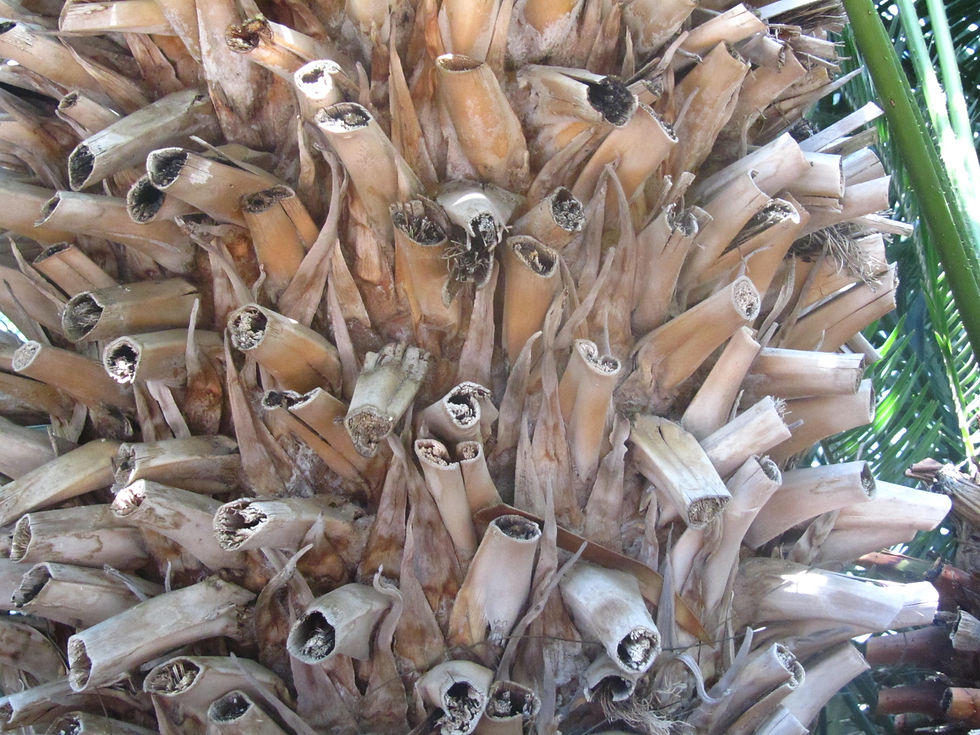
Encephalartos paucidentatus is a short, sometimes suckering cycad. Leaves are straight, 1.5 to 2.5 m long and 30 to 50 cm wide, pinnate, on a 20 to 30 cm long, yellowish leafstalk. They have many pairs of leaflets, 15 to 25 cm long and 2 to 3.5 cm wide. Leaflets are usually falcate, slightly toothed, gradually pointed at the tip, and reduced to lobes and spines near the base of the leaf. They are dark glossy green above, light yellowish below, with many prominent longitudinal veins on the lower surface. Male (pollen) cones are in clusters of up to five, narrow, erect, 40 to 60 cm tall and 12 to 15 cm wide, golden brown, woolly at first but then becoming smooth. The stalk is 10 to 12 cm long and 2.5 to 3 cm in diameter. Sporophylls (cone “scales”) are 4 to 5.5 cm long, angled and faceted, with the main facet being 12 to 15 mm high and 25 mm wide, with a beak that is pointed downwards. Seeds are borne on separate plants. Female cones hold seeds, and are in clusters of up to three. They are bright yellow, ovoid, about 30 to 50 cm long, 20 to 25 cm wide, on a 3 cm long stalk. Sporophylls have faces that are 25 to 28 mm high, 40 to 45 mm wide, angled downwards. Seeds are about 3.5 to 4.0 cm long, 1.9 to 2.2 cm wide, with an outer layer (sarcotesta) that is red (Whitelock 2003).
Encephalartos paucidentatus is most similar to Encephalartos heenanii, which grows in the same area. E. heenanii has leaves usually shorter than 1.2 m, with light green leaflets. The leaflets, stem, and cones are covered in a dense brown wool (Palgrave 2015).
Encephalartos paucidentatus is most similar to Encephalartos heenanii, which grows in the same area. E. heenanii has leaves usually shorter than 1.2 m, with light green leaflets. The leaflets, stem, and cones are covered in a dense brown wool (Palgrave 2015).
Uses
Note: Please see the disclaimer regarding any information about medical or edible uses.
Encephalartos paucidentatus, despite being rare and endangered, is occasionally found in collections and does well in cultivation (Whitelock 2003).
Distribution
Encephalartos paucidentatus is restricted to mountain forests on steep, rocky slopes, at an altitude of about 1800 m. It is only found near Barberton, South Africa and Piggs Peak, Swaziland (Eswatini) (Whitelock 2003).
Status
Encephalartos paucidentatus is listed on the IUCN Red List as "Vulnerable". It is threatened by habitat destruction for wood plantations, as well as illegal collecting of the species. It is listed in Appendix I of CITES, an international treaty regulating the trade of endangered species (Donaldson 2010).
References
Donaldson, J. S. 2010. Encephalartos paucidentatus. The IUCN Red List of Threatened Species. https://dx.doi.org/10.2305/IUCN.UK.2010-3.RLTS.T41921A10597621.en.
Palgrave, K. C. 2015. Palgrave's Trees of Southern Africa. 3rd ed. Cape Town: Penguin Random House South Africa.
Whitelock, L. M. 2003. The Cycads. Portland: Timber Press.
Palgrave, K. C. 2015. Palgrave's Trees of Southern Africa. 3rd ed. Cape Town: Penguin Random House South Africa.
Whitelock, L. M. 2003. The Cycads. Portland: Timber Press.
Description
bottom of page