top of page
Dioon spinulosum
Dyer ex Eichl.
Giant Dioon
Zamiaceae
Dioon spinulosum is a large species of cycad in the family Zamiaceae. It is native to the eastern slopes of the the state of Oaxaca in Mexico. It is well-adapted to cultivation, and its seeds have been used as food.


Description
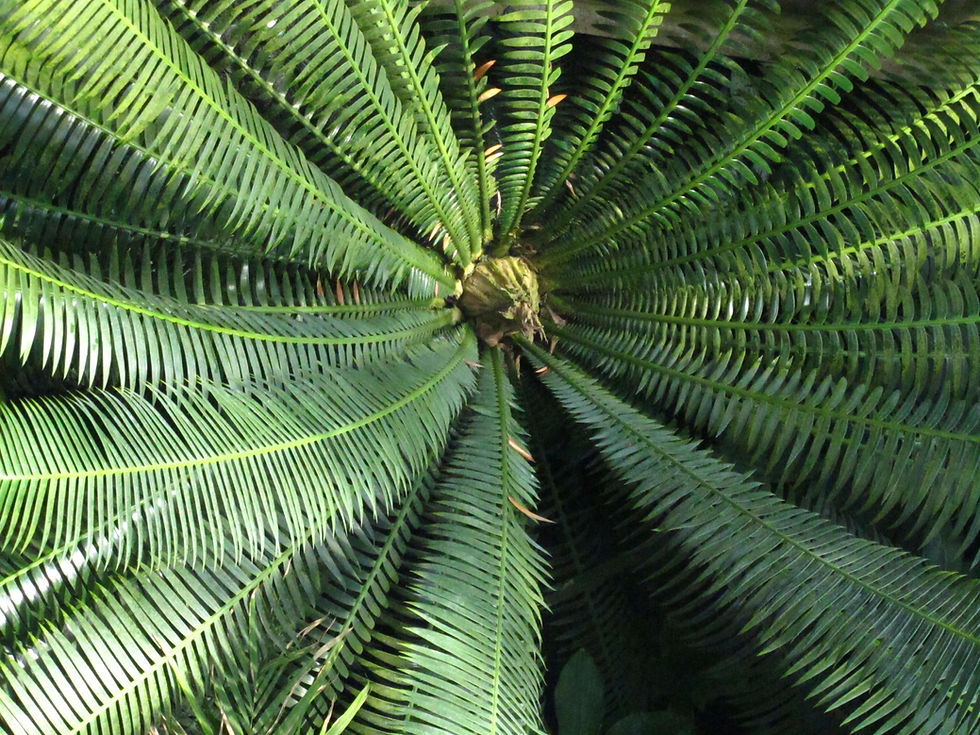
Dioon spinulosum is a tree-sized cycad; in fact, it is the second-tallest, growing to about 3 to 12 m tall or occasionally over 16 m. The bottom of the trunks often become smooth with age. Leaves are huge, 1.5 to 2 m long and 30 to 40 cm wide, pinnate; young leaves have long, unarmed leafstalks. They are gray-green and glaucous (covered with whitish bloom). Each leaf has 80 to 117 pairs of narrow, pointed leaflets that are about 15 to 20 cm long and 1 to 1.5 cm wide. Leaflets have margins rolled downwards (i.e. revolute), with a few short spines along the margins; they are tilted downwards near the tip. In older plants the basal leaflets may be reduced to simple spines. Male (pollen) cones are large, 21 to 50 cm tall and 10 to 13.7 cm wide, cylindrical, and densely covered with hairs. The stalk is often too short to be visible. Sporophylls (cone “scales”) are triangular, 14 to 25 mm high and wide. Seeds are borne on separate trees. Female cones hold seeds, and are more round, ovoid, about 35 to 50 cm long, 20 to 27 cm wide, on a relatively long (20 to 30 cm long) stalk. Sporophylls are 7.5 to 8 mm long, densely overlapping, with broad triangular faces. Both male and female cones are erect at first but then becoming drooping. Seeds are about 4 to 5.5 cm long, 2.5 to 3.5 cm wide, and yellow when ripe (Whitelock 2003).
Uses
Note: Please see the disclaimer regarding any information about medical or edible uses.
Indigenous people have used the seeds of Dioon spinulosum as food. A starchy, flour-like substance can be made by shelling, grinding, and washing the seeds to remove poisons. Leaves are also used as decoration. The species is easily and often grown. It grows relatively quickly; it requires good soil drainage and can withstand full sun and even some frost (Whitelock 2003).
Distribution
Dioon spinulosum is found in tropical evergreen forests on limestone soils, at relatively low elevations of 20 to 300 m. It is native to the Mexican state of Oaxaca. It was formerly found in Veracruz, north to Tierra Blanca and east to Lago Catemaco (Whitelock 2003).
Status
Dioon spinulosum is listed on the IUCN Red List as "Endangered". Already restricted to a small range, it is threatened with habitat destruction for farming, ranching, and reservoirs. It has also been over-collected in the past. It is listed in Appendix II of CITES, an international treaty regulating the trade of endangered species (Vovides et al. 2010).
References
Vovides, A., Chemnick, J., and Gregory, T. 2010. Dioon spinulosum. The IUCN Red List of Threatened Species. https://dx.doi.org/10.2305/IUCN.UK.2010-3.RLTS.T42149A10667709.en.
Whitelock, L. M. 2003. The Cycads. Portland: Timber Press.
Whitelock, L. M. 2003. The Cycads. Portland: Timber Press.
Description
bottom of page