top of page
Ceratozamia mexicana
Brongn.
Mexican Horncone
Zamiaceae
Ceratozamia mexicana is a species of cycad in the family Zamiaceae. It is restricted to the state of Veracruz, Mexico.


Description
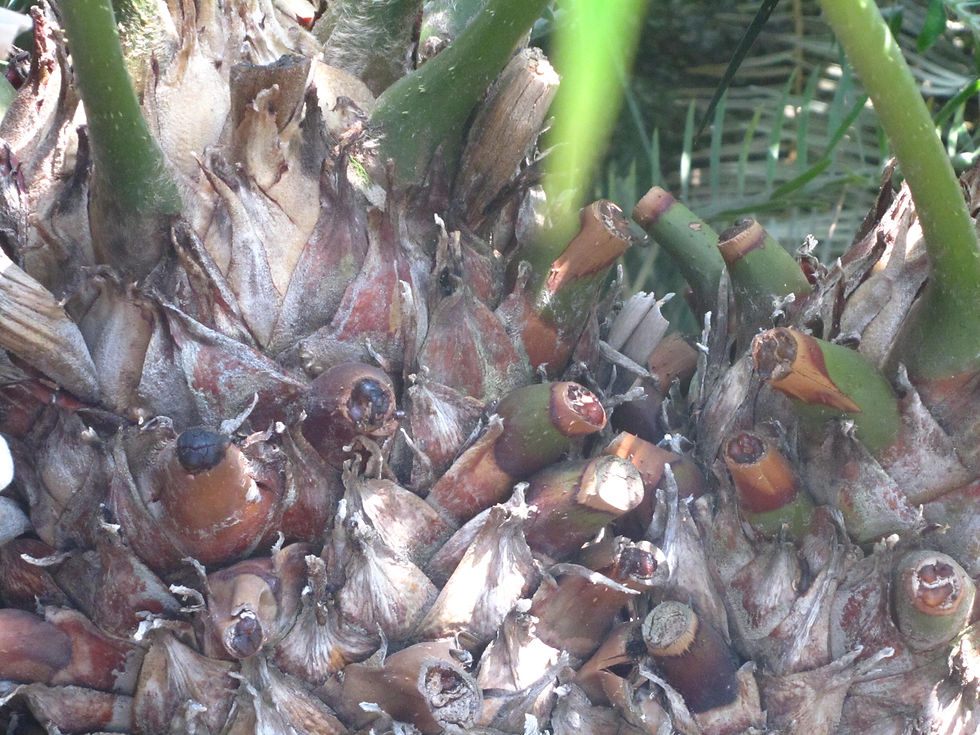
Ceratozamia mexicana is a short, sometimes suckering cycad. Leaves are numerous, 1.5 to 2 m long and up to 75 cm wide, pinnate, on a 30 to 50 cm long, spiny leafstalk. They have about 40 to 60 pairs of stiff leaflets, 28 to 40 cm long and 1.5 to 2 cm wide; the edges of the leaflets are smooth, rolled downwards. Leaflets are pointed at the tip, glossy green above and lighter below. Male (pollen) cones are long and conical, erect, 38 to 43 cm tall and 7 to 8 cm wide, green, with a blunt tip. The stalk is 7.5 to 10 cm long, 2.5 cm in diameter, densely fuzzy-hairy. Sporophylls (cone “scales”) are generally about 6 mm high and 15 to 17 mm wide with two “horns”. Seeds are borne on separate plants. Female cones hold seeds. They are cylindrical and abruptly pointed at the tip, erect at first but then start to lean, about 26 to 35 cm long, 9 to 12 cm wide, on a 6 to 10 cm long stalk. Sporophylls have faces that are 18 to 25 mm high, 27 to 35 mm wide, two-pointed, with some blackish scales near the center. Seeds are about 2.3 to 3.0 cm long, 1.5 to 1.8 cm wide, with an outer layer (sarcotesta) that is white, ripening to brown (Whitelock 2003).
Uses
Note: Please see the disclaimer regarding any information about medical or edible uses.
Ceratozamia mexicana can easily be grown as a houseplant and is found in botanical gardens around the world. It can tolerate shade, frost, and dry atmospheres, but has brittle and delicate leaves. It prefers damp soil with good drainage (Whitelock 2003).
Distribution
Ceratozamia mexicana is restricted to steep hills and canyons, usually in pine-oak forest at elevations of about 1550 m. It is endemic to the Mexican state of Veracruz, northeast of Jalapa (Whitelock 2003).
Status
Ceratozamia mexicana is listed on the IUCN Red List as "Vulnerable". Its range, already quite small, has additionally been reduced due to habitat destruction for agriculture, cattle farming, and charcoal production. It is listed in Appendix I of CITES, an international treaty regulating the trade of endangered species (Vazquez et al. 2010).
References
Vazquez, M., Bojorquez, H., Torres, L., Sanchez-Moreno, S., Sanchez-Morales, L., and Torres-Hernandez, L. 2010. Ceratozamia latifolia. The IUCN Red List of Threatened Species. https://dx.doi.org/10.2305/IUCN.UK.2010-3.RLTS.T42141A10665184.en.
Whitelock, L. M. 2003. The Cycads. Portland: Timber Press.
Whitelock, L. M. 2003. The Cycads. Portland: Timber Press.
Description
bottom of page