top of page
Carnegiea gigantea
(Engelm.) Britton & Rose
Saguaro
Cactaceae
Carnegiea gigantea is a large tree-sized cactus in the family Cactaceae. This iconic plant is native to the Sonoran Desert, where it is arguably one of the premier symbols of the American Southwest; it is the state flower of Arizona (FNAEC 2004). It is commonly cultivated as an ornamental and used locally for food and construction.
Description
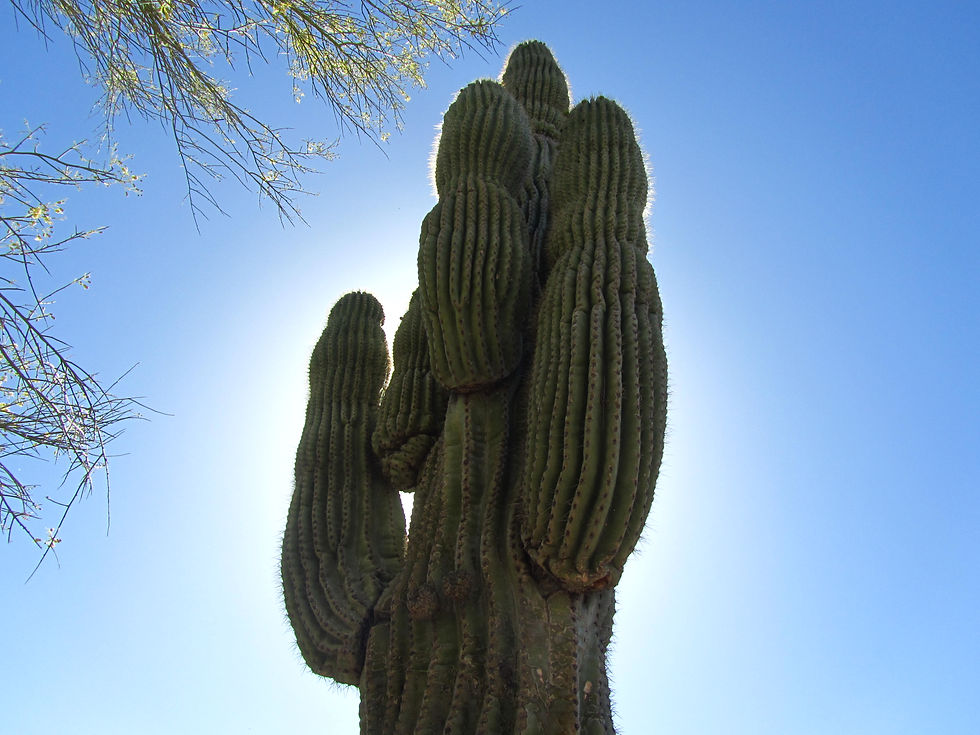
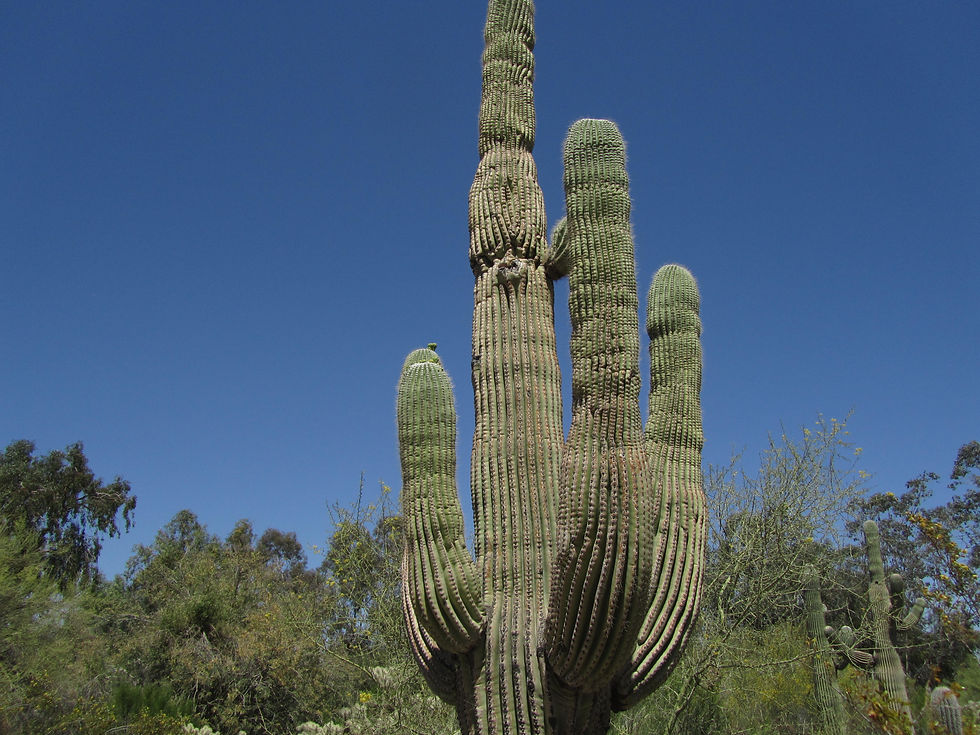
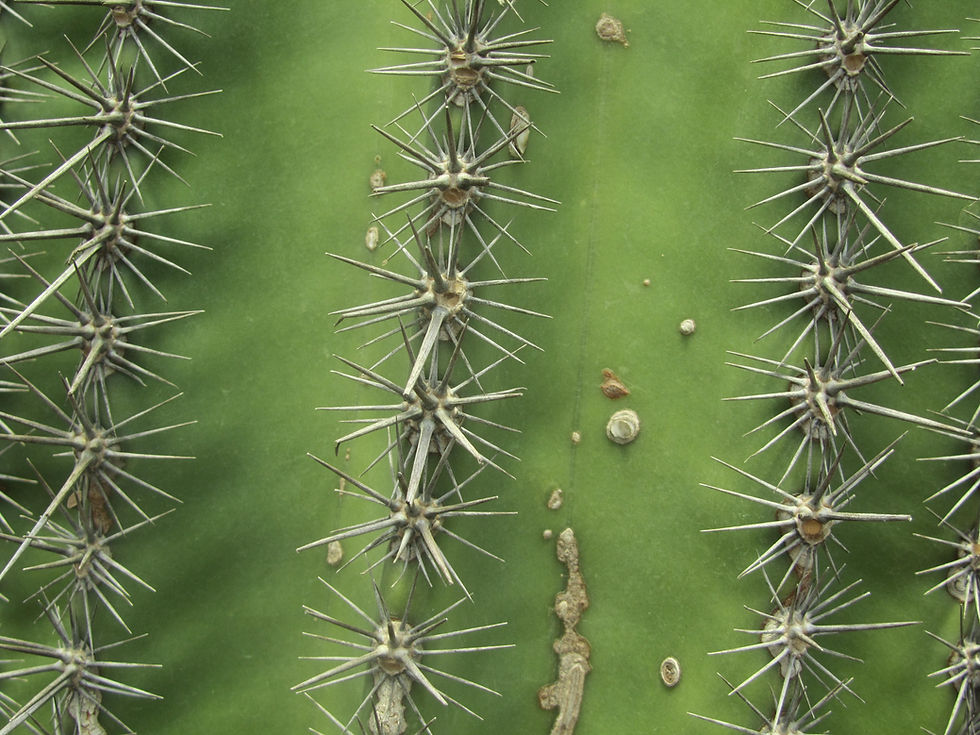
Carnegiea gigantea typically grows up to 6 m, but occasionally up to 20 m, with a single trunk and often a few branches (Sibley 2009). Carnegiea gigantea, typical of most cacti, does not have typical leaves. Photosynthesis takes place in the stem, which is green, columnar, about 25 to 75 cm; when old, it becomes a hard gray bark. Stems have around 20 to 30 longitudinal ribs. Spines (which are modified leaves) grow out of clusters called areoles that are covered in whitish hairs. Each areole has about 15 to 28 spines that are stiff, grayish, and hard; lateral spine are about 1 to 2 cm long, shorter than the central spines which are 3 to 5 cm long. Flowers are bisexual, borne on the top of stems, nocturnal but staying open the next day, from May to June. They are about 6.5 to 8.5 cm long; sepals (technically outer tepals) are greenish, while petals (inner tepals) are white, curved backwards, with many whitish stamens. The fruit is about 5 to 10 cm long and 2.5 to 4.5 cm wide, round, occasionally somewhat spiny, maturing red. Seeds are dark brown, 1.5 mm long, and glossy (FNAEC 2004).
Carnegiea gigantea is quite distinctive in its range. It may be confused with the organ pipe cactus (Stenocereus thurberi) and senita cactus (Lophocereus schottii), but both those species are branched at the base, while Carnegiea gigantea usually has a single trunk (FNAEC 2004).
Carnegiea gigantea is quite distinctive in its range. It may be confused with the organ pipe cactus (Stenocereus thurberi) and senita cactus (Lophocereus schottii), but both those species are branched at the base, while Carnegiea gigantea usually has a single trunk (FNAEC 2004).
Uses
Note: Please see the disclaimer regarding any information about medical or edible uses.
Carnegiea gigantea is often cultivated as an ornamental, particularly in desert gardens; it grows in USDA zones 8 to 10. In and around its native range, it is adapted to (and can tolerate) harsh conditions; for example, it absorbs and stores water in its body to survive droughts. Transplanting Carnegiea gigantea is the main challenge; younger plants are more likely to survive transplanting, as their root systems are not as extensive. Locally there are strict regulations on removing these plants from the wild (Chamberland 2021).
The ribs (the internal frame) of Carnegiea gigantea plants are used in walls, furniture, and handicrafts; this has contributed to over-collecting of the species. The fruits are edible but can also be used to make wine and jam (FNAEC 2004; Burquez Montijo et al. 2017).
The ribs (the internal frame) of Carnegiea gigantea plants are used in walls, furniture, and handicrafts; this has contributed to over-collecting of the species. The fruits are edible but can also be used to make wine and jam (FNAEC 2004; Burquez Montijo et al. 2017).
Distribution
Carnegiea gigantea is a major component of the Sonoran Desert scrub, at altitudes of up to 1400 m. It is native to Arizona, southwestern California, and the Mexican state of Sonora (FNAEC 2004; Burquez Montijo et al. 2017).
Status
Carnegiea gigantea is listed on the IUCN Red List as “Least Concern”. In its native range, it is common and widespread, but the population is decreasing. The main threats are habitat conversion (for urbanization in the United States and cattle ranching in Mexico), collecting or poaching, and competition from invasive species such as buffel grass (Cenchrus ciliaris) (Burquez Montijo et al. 2017).
References
Burquez Montijo, A., Butterworth, C., Baker, M. and Felger, R. S. 2017. Carnegiea gigantea (amended version of 2013 assessment). The IUCN Red List of Threatened Species. https://dx.doi.org/10.2305/IUCN.UK.2017-3.RLTS.T152495A121476885.en.
Chamberland, M. 2021. Saguaro Horticulture: Habitats For Wild And Cultivated Saguaro. The University of Arizona Cooperative Extension. [accessed 2022 Aug 22]. https://extension.arizona.edu/sites/extension.arizona.edu/files/pubs/az1933-2021.pdf
FNAEC (Flora of North America Editorial Committee), editor. 2004. Flora of North America, north of Mexico. Volume 4: Magnoliophyta: Caryophyllidae, Part 1. New York: Oxford University Press.
Sibley, D. A. 2009. The Sibley Guide to Trees. New York: Alfred A. Knopf.
Chamberland, M. 2021. Saguaro Horticulture: Habitats For Wild And Cultivated Saguaro. The University of Arizona Cooperative Extension. [accessed 2022 Aug 22]. https://extension.arizona.edu/sites/extension.arizona.edu/files/pubs/az1933-2021.pdf
FNAEC (Flora of North America Editorial Committee), editor. 2004. Flora of North America, north of Mexico. Volume 4: Magnoliophyta: Caryophyllidae, Part 1. New York: Oxford University Press.
Sibley, D. A. 2009. The Sibley Guide to Trees. New York: Alfred A. Knopf.
Description
bottom of page