top of page
Pinus torreyana
Parry ex Carrière
Torrey Pine
Pinaceae
Pinus torreyana is a rare coniferous tree in the family Pinaceae. It is restricted to a few populations in southern California, and is the rarest pine species in North America.


1/3
Description
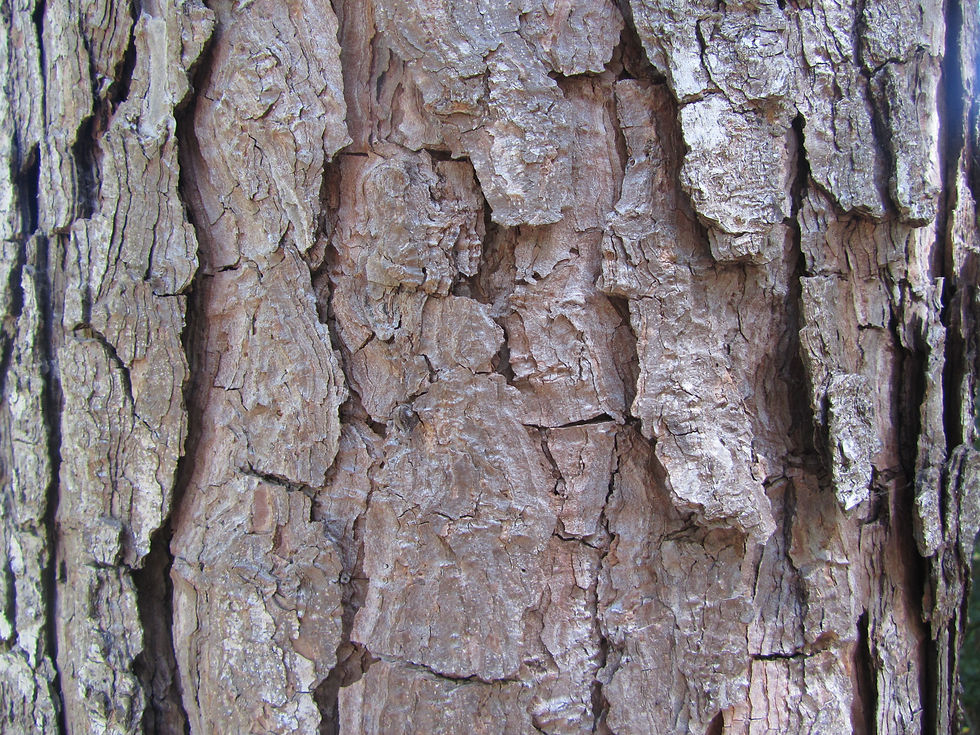
Pinus torreyana is a medium-sized tree, growing up to 25, sometimes 40 m tall with a trunk that grows 1 to 2 m wide. It forms a conical, then open and broad crown. Branches are thick, with leaves clustered around the tips. Needles are stiff, straight or slightly twisted, relatively long, typically around 18 to 30 cm in bundles of 5, occasionally 3 or 4. They are dull yellow green or bluish green with bands (which are stomata) on all sides of the leaves, and they persist on the tree for 2 to 4 years. Sheaths are typically 2 to 3 cm long, and are persistent. Buds are 1.5 to 2.5 cm long and resinous. The bark is reddish to grayish brown, broken up into scaly plates. Twigs are brownish, rough from the bases of the leaves and are hairless. Pollen cones are 4 to 6 cm, yellow. Seed cones are 9 to 16 cm long, broadly egg-shaped, and on stalks 2 to 4 cm long. They are green, ripening to dark brown. Cones have 60 to 80 scales that are paddle-shaped, with the face being pyramidal with a triangular pointed tip. These cones open widely to release their seeds and stay on the tree for several years. Seeds are 15 to 25 mm long, with an easily detachable wing that is 10 to 15 mm long (Eckenwalder 2009).
Two subspecies are commonly named: the mainland Torrey pine (ssp. torreyana) found in mainland California, and island Torrey pine (ssp. insularis). The island form has broader cones with umbos (the tips of cone scales) more curved outwards, and averages larger seeds (FNAEC 1993). However, the genetic diversity within the species is very small, and the two subspecies are not very distinguishable anyway, so separating them may be unnecessary (Eckenwalder 2009).
Two subspecies are commonly named: the mainland Torrey pine (ssp. torreyana) found in mainland California, and island Torrey pine (ssp. insularis). The island form has broader cones with umbos (the tips of cone scales) more curved outwards, and averages larger seeds (FNAEC 1993). However, the genetic diversity within the species is very small, and the two subspecies are not very distinguishable anyway, so separating them may be unnecessary (Eckenwalder 2009).
Uses
Note: Please see the disclaimer regarding any information about medical or edible uses.
Distribution
Pinus torreyana forms open, pure stands in grassy or shrubby areas, at altitudes of 50 to 150 m. It is restricted to San Diego County near Del Mar, and Santa Rosa Island (Eckenwalder 2009).
Status
Pinus torreyana is listed on the IUCN Red List as “Critically Endangered”. It is the rarest pine species in North America (FNAEC 1993), and its small population is very prone to fires, pests, or disease. The mainland population is threatened by urbanization in the surrounding area (Farjon 2013).
References
Eckenwalder, J. E. 2009. Conifers of the world: the complete reference. Portland: Timber Press.
Farjon, A. 2013. Pinus torreyana. The IUCN Red List of Threatened Species. https://dx.doi.org/10.2305/IUCN.UK.2013-1.RLTS.T42424A2979186.en.
FNAEC (Flora of North America Editorial Committee), editor. 1993. Flora of North America, north of Mexico. Volume 2: Pteridophytes and Gymnosperms. New York: Oxford University Press.
Farjon, A. 2013. Pinus torreyana. The IUCN Red List of Threatened Species. https://dx.doi.org/10.2305/IUCN.UK.2013-1.RLTS.T42424A2979186.en.
FNAEC (Flora of North America Editorial Committee), editor. 1993. Flora of North America, north of Mexico. Volume 2: Pteridophytes and Gymnosperms. New York: Oxford University Press.
Description
bottom of page