top of page
Pinus sylvestris
L.
Scots Pine
Pinaceae
Pinus sylvestris is a coniferous tree in the family Pinaceae. It is widely distributed from western Europe to East Asia, and is an important timber tree. It is the national tree of Scotland (FALS).


Description
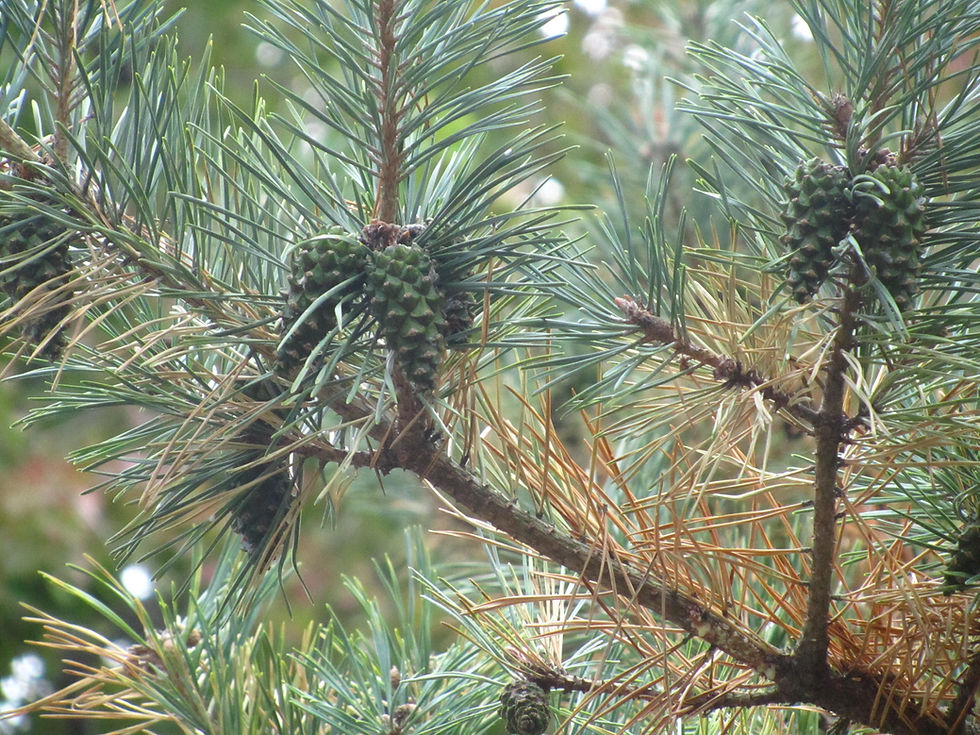
Pinus sylvestris is a medium-sized tree, growing up to 30 to 40 m tall with a trunk that grows up to 1 to 1.7 m wide. It forms a roughly conical to cylindrical or even spherical crown, with branches that are contorted, horizontal or ascending. Needles are very broad and twisted, typically 4 to 7 cm in bundles of 2, sometimes 3. They are bluish green with conspicuous bands (which are stomata) on both sides of the leaves, and they persist on the tree for 2 to 3, but sometimes up to 9 years. Sheaths are 9 to 12 mm long, and are persistent. Buds are typically 5 to 8 mm long, and are resinous. The bark is reddish orange, flaky when young, becoming dark gray and scaly near the bottom. The trunk has a distinctive appearance, looking dull gray near the bottom but becoming orange higher up the tree. Twigs are greenish to orange, and are hairless. Pollen cones are around 3 to 6 mm, pink or yellow. Seed cones are typically 3 to 5 cm long, ovoid, and around 4 to 12 mm long. They are green, ripening to grayish, yellowish, or reddish brown. Cones have 70 to 100 scales that are paddle-shaped; the exposed face has a diamond-shaped pyramid and a small, blunt prickle. These cones open widely to release their seeds and fall from the tree. Seeds are around 3 to 5 mm long, with an easily detachable wing that is 10 to 15 mm long (Eckenwalder 2009).
Being the most widely distributed pine, P. sylvestris also displays immense variety in terms of morphology, but none of these variations are likely to be actual subspecies or varieties (Eckenwalder 2009).
Being the most widely distributed pine, P. sylvestris also displays immense variety in terms of morphology, but none of these variations are likely to be actual subspecies or varieties (Eckenwalder 2009).
Uses
Note: Please see the disclaimer regarding any information about medical or edible uses.
Pinus sylvestris is very important for timber, being grown for that purpose in Western Europe and North America. It is mainly used for paper, but can be used for a wide variety of construction uses. A tar, called “Stockholm tar”, can be extracted from its wood (Gardner 2013). The species is commonly cultivated, including for Christmas trees, with many different cultivars including dwarf forms. It grows in moist, well-drained, and acidic soils in full sun; it grows in USDA zones 2 to 7, but does not do well in heat (MBG).
Distribution
Pinus sylvestris is the most widely distributed pine species. It ranges from isolated occurrences in Scotland and northern Spain, to most of the Scandinavian Peninsula and Turkey and the Caucasus Mountains, all the way to the Russian Far East, Mongolia, and northeastern China (Garner 2013). Additionally, it is extensively naturalized in eastern North America (Kartesz 2015). As such, it grows in a wide variety of soils, all nutrient poor, such as podzol, rocky soils, and peat bogs. It commonly grows alongside other conifers and boreal broad-leaved trees such as birches (Betula spp.) and European aspen (Populus tremula) (Gardner 2013).
Status
Pinus sylvestris is listed on the IUCN Red List as "Least Concern", as it is extremely widely distributed—in fact, it is the most widely distributed of pines (Gardner 2013).
References
Eckenwalder, J. E. 2009. Conifers of the world: the complete reference. Portland: Timber Press.
FALS (Forestry and Land Scotland), Scots pine. Forestry and Land Scotland. [accessed 2019 Dec 17]. https://forestryandland.gov.scot/learn/trees/scots-pine.
Gardner, M. 2013. Pinus sylvestris. The IUCN Red List of Threatened Species. http://dx.doi.org/10.2305/IUCN.UK.2013-1.RLTS.T42418A2978732.en.
Kartesz, J. T., The Biota of North America Program (BONAP). 2015. North American Plant Atlas. (http://bonap.net/napa). Chapel Hill, N.C. [maps generated from Kartesz, J.T. 2015. Floristic Synthesis of North America, Version 1.0. Biota of North America Program (BONAP). (in press)].
MBG (Missouri Botanical Garden), Pinus sylvestris. Plant Finder. [accessed 2019 Dec 13]. http://www.missouribotanicalgarden.org/PlantFinder/PlantFinderDetails.aspx?kempercode=c229
FALS (Forestry and Land Scotland), Scots pine. Forestry and Land Scotland. [accessed 2019 Dec 17]. https://forestryandland.gov.scot/learn/trees/scots-pine.
Gardner, M. 2013. Pinus sylvestris. The IUCN Red List of Threatened Species. http://dx.doi.org/10.2305/IUCN.UK.2013-1.RLTS.T42418A2978732.en.
Kartesz, J. T., The Biota of North America Program (BONAP). 2015. North American Plant Atlas. (http://bonap.net/napa). Chapel Hill, N.C. [maps generated from Kartesz, J.T. 2015. Floristic Synthesis of North America, Version 1.0. Biota of North America Program (BONAP). (in press)].
MBG (Missouri Botanical Garden), Pinus sylvestris. Plant Finder. [accessed 2019 Dec 13]. http://www.missouribotanicalgarden.org/PlantFinder/PlantFinderDetails.aspx?kempercode=c229
Description
bottom of page